When Nothing Happens Equals Job Well Done
Nobody walks into a building and checks whether it's going to fall down. We just trust that the building will stand there as intended. And the moment you stop noticing a system altogether is a system doing its job perfectly.
That's the trap of anything that actually works. But the invisibility of effort isn't the same as the absence of effort.
So how can an entire organization, made up of 70,000+ members, build themselves around a definition of success that looks like nothing at all?
The Grain Doesn’t Lie
When it comes to art, and the idea of molding stellar creations out your material of choice, there is one common skill that each great builder has.
Patience.
Whether wood or metal, acrylic or oil, every great artist has patience. But we’re not talking about the passive kind. We’re talking about the kind that builds projects people love and cherish for years to come.
Believe it or not, we can learn from this kind of patience. And what we can learn is a lesson construction has desperately needed.
We’re Actually on the Same Side
In construction, the contract has become a secret weapon. Yet while it’s a system designed to pit us against each other, that doesn't have to mean we have to be adversaries.
Instead, when you approach a redline from the place of a shared end goal (completing the project), negotiations stop feeling like an attack. They’re simply two people trying to accomplish the same thing, faster and with less pain.
It sounds super simple, right? So why is it almost never how things actually play out?
Profitable on Paper, Broke in Practice
Your P&L says you made money last year, but for some reason it doesn’t feel like it. That’s because you’re looking at the wrong number. Revenue.
Here’s the thing, revenue is not health. In fact, it never was.
So that number you're proudest of might just be the least real number in your books.
The Realest Superpower on Any Site
Superpowers are awesome. Every one of us at some point has dreamed of flying. Or of having super strength. Or of the “Spidey sense” that warns us of something being wrong before we can see it.
Unfortunately while they may be helpful, none of those can be used to build buildings.
So this week, we had a little fun debating what the coolest superpowers are and whether it’s the power or the person that makes the hero great?
It was a fun conversation, but in the end, the real moment of this debate isn’t about the comics at all.
The Vacation Test
Honest question for you. Would your pipeline survive you turning your phone off for a week?
Not "would things get a little messy," but truly hold momentum and lock down deals while you're away.
For most teams across construction, the answer is no. The good news is, that's not a people problem. The bad news is, it’s a much more difficult problem to solve.
Toughness is a Material. Resilience is a Structure.
If you’ve been around construction long enough, you’ve learned a tough lesson you’ll ultimately carry for life: even the strongest steel in the world still fails. Not because it's weak, but because of fatigue.
Stephanie Lemek has learned the exact same lesson. Only to her, we’re talking about something much more important than steel.
We’re talking about our teams in the field.
The Dinner Party Test
There’s a moment in every contech sales cycle that is tough to ignore. The deck is polished. The features are real. The ROI is documented. And yet, nothing. No sales. No traction.
Many point at the luddites of construction and blame the industry. They call it change-resistant. They call it slow.
But Colin Crook, founder of FractalPR, has a different diagnosis.
Trust Has No Neutral Transactions
There's a lie that runs across many construction sites, and it goes a little something like this: "It’s not a big deal."
Whether it be the missed callback or the days-late follow up, we all too often ourselves those things are trivial. That people don't even notice.
Well, they notice.
That’s why Joel Bennett set out on a mission to teach leaders in construction a unique skill. How to actually operationalize trust.
The Tool Isn’t Impressive, Trust Is
Which matters more, how impressive a tool is or how trustworthy it is? When I sat down with Brian Tracy, who literally co-authored the textbook on managing construction technology, his answer certainly caught me off guard.
“A tool is impressive to me by how trustworthy it is.”
Maybe that’s cheating, but honestly he’s not wrong. And the more you dig in, the more you realize that’s how we constantly miss the point with contech.
The Safety Net is the Saboteur
Four out of five digital transformations fail. That's an 80% strikeout rate which, even in baseball, isn’t very good at all.
And of course, we just love to blame that on the software. The clunky, broken, overpromised software. I get it, sometimes that might be true. But after twenty years of ConTech, it’s become clear that failure is rarely about the tool and more about the back door we leave open.
But don’t just take my word for it. Take from the guy who literally wrote the book on implementation.
You’re Not Hiring Talent. You’re Building a Coaching Tree
Construction doesn't have a talent shortage. It has a coaching tree shortage.
A shortage is something you fix with better recruiting. A tree is something you can only solve with intentional decisions compounded over years.
The challenge for construction right now is nearly half the workforce will retire in the next five years. That means we’re about to quickly learn who built trees and who just built rosters.
Invisible PPE: The Human Under the Hat
We've spent fifty years getting really good at protecting construction workers.
Better gloves, glasses, hard hats and boots. Better harnesses, vests and signage. Even better toolbox talks, incident reporting and stand-downs. We have stacked layer upon layer of PPE and processes in an effort to eliminate the ways someone can get hurt on a job site.
And yet construction loses five times more people to one particular cause than any other physical fatalities.
Suicide.
So either we're protecting the wrong thing, or we're simply pretending that physical PPE is enough.
The Opportunity is There, Explore the Trades
We don’t have a labor shortage problem in construction. We have a story problem.
We talk about demand, stability, earning potential and even long-term growth. But despite all of that, we still can’t attract enough people to fill the need. The opportunities alone aren’t compelling enough to make someone choose construction.
It’s a contradiction that’s hard to ignore.
And that’s where Explore the Trades steps in. Not to simply promote the trades, but to connect the next generation in a way that draws them in.
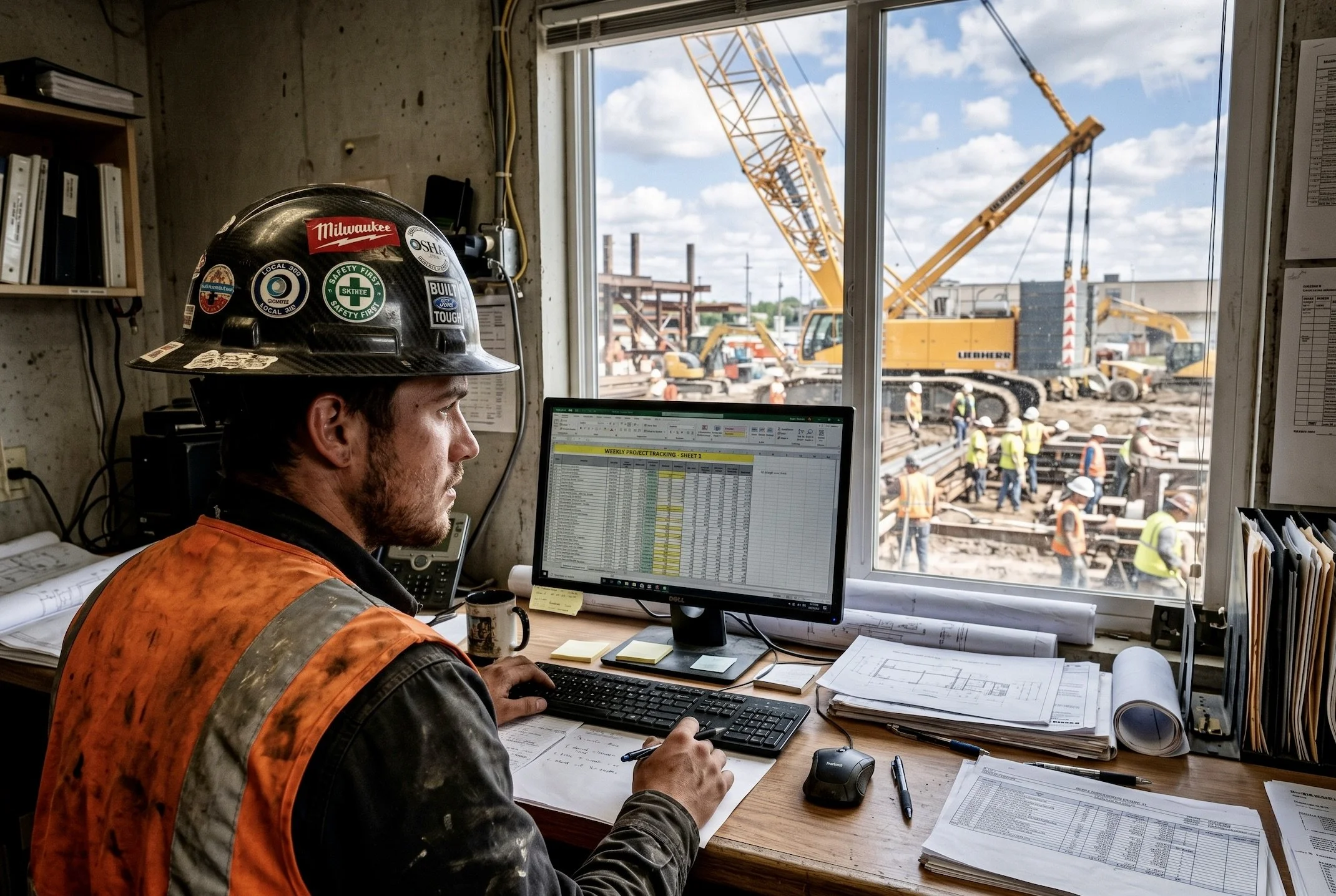
Pick Your Pain: To Change or Not
Believe it or not, there are two kinds of pain available to you in every major change. Whether it be a shift in process, tech or culture, we actually control our pain.
The first is obvious, the pain of changing. The second is more subtle, the long, slow accumulation of brokenness from choosing to remain stagnant.
All too often, construction chooses the latter thanks to the inherent risk avoidant nature of our industry.
But that mentality is costing us dearly.
The Moat is Gone. Now What?
Sometimes being right isn’t enough.
In fact, there’s a rare combination in engineering, being both deeply technical and deeply relational, that many engineers spend a career learning the hard way.
If they learn it at all.
So, in an industry that tends to treat these two things as mutually exclusive, Nick Heim has made it his mission to bridge the gap.
Especially now, as AI is begins to remove the moat of technical differentiation.
The Tech Isn’t the Problem. The Disconnect Is.
It happens all the time in construction. A new piece of technology is introduced using all the right buzzwords.
Revolutionary. Transformational. Game-changing.
But over time, it slowly fades into the background. Not because anyone made a decision to abandon it, but because it never became part of how the work actually got done in the first place.
For the most part, we’ve treated these moments like isolated misses and, of course, tell ourselves the next one will be different. But the more we do this it becomes increasingly clear, nothing about these misses are random.
They’re a pattern.
The Idea is Only Half the Work
We’ve all been there. Mid-conversation, fully in our flow…when then we see it. That look. The look of total confusion, written all over the other person’s face. That’s when it hits us.
Understanding something and explaining something are not the same thing.
In an industry like construction, where alignment is everything and miscommunication is expensive, the ability to explain something is so much more than a just soft skill.
Stop Chasing Tech. Start Building Strategy.
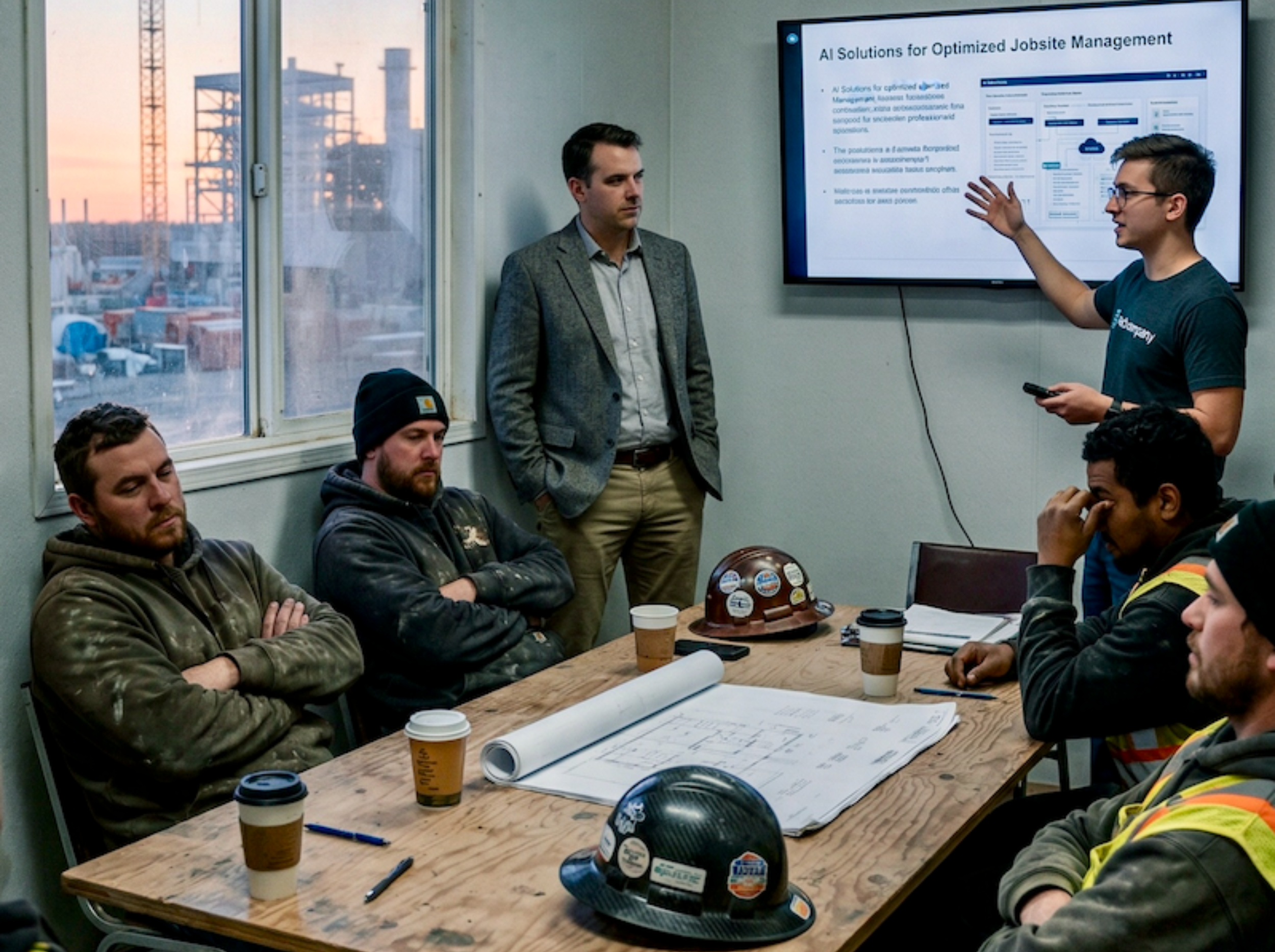
If I were to ask you how many software subscriptions your organization currently paid for, could you answer?
That question may be a little tough for you to answer, and the truth is, you’re not alone. There is an industry-wide problem that we’re ashamed to admit.
Construction doesn't have a tech problem. It has a strategy problem.
And no amount of new AI-powered software is going to fix it.
The Hardest Problems in Construction Have Nothing to Do with Tech
Many times, when something is wrong, we notice right away. Other times, it may take a friend pointing it out. But every so often, the most important lesson comes from a wakeup call. Literally.
That’s how it all started for Ian Gray, a long-time construction advisor and co-host of the Salty & Wired podcast. And while his first instinct was that he “must be the weird one,” he soon realized that the construction industry's hardest problems weren't living inside a process flow diagram or an RFI.
They were living inside the people building the projects.
