The Opportunity is There, Explore the Trades
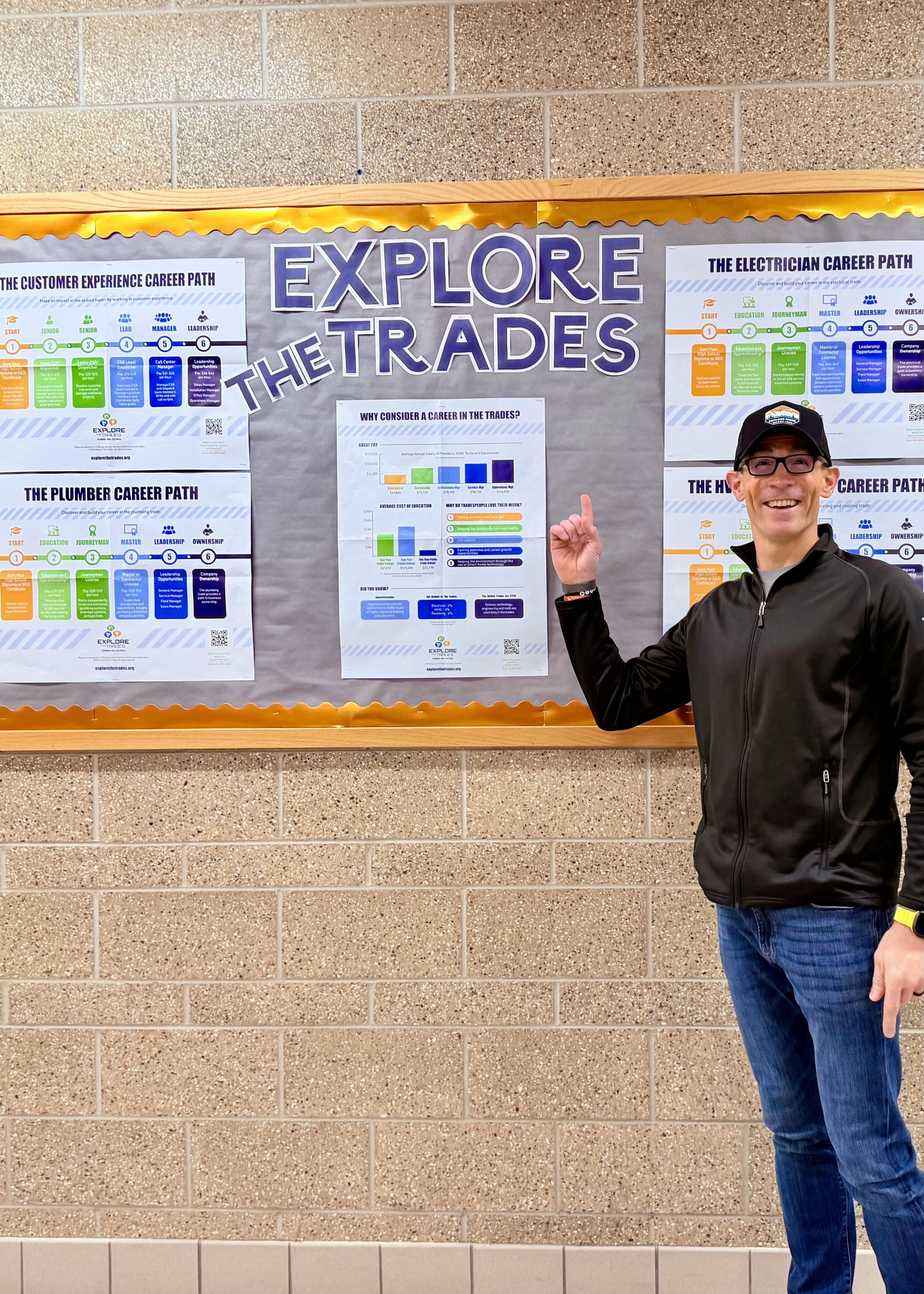
Explore the Trades featured on a high school bulletin board in Indiana.
We don’t have a labor shortage problem in construction. We have a story problem.
There are serendipities in life, aren’t there? Those moments that don’t look like much on the surface, but for some reason they stick with you. Recently, one of those moments happened to me in a high school hallway in Indiana. There was this bulletin board, the kind you’ve walked past a thousand times without a second thought, and I just had to take a picture. Meanwhile, my wife was behind the camera wondering why I cared so much about a piece of cork and paper.
But that particular board was doing something construction has struggled to do for decades. It was telling a better story.
And it wasn’t just about what it said, but also what it revealed. We are an industry that constantly talks about opportunity. We talk about demand, stability, earning potential and long-term careers. The opportunity is real. It’s everywhere.
And yet, despite all of that, we still can’t attract enough people to fill it.
That contradiction is hard to ignore. Sure, there’s loads of opportunity out there, but the problem is those opportunities alone aren’t compelling enough to make someone choose construction.
That right there is where Kate Cinnamo and Explore the Trades comes in, the people behind the board that stopped me in my tracks. Kate lives in this exact tension every day, but her superpower isn’t just promoting the trades. It’s connecting meaningful purpose to the next generation of builders in a way that actually draws them in.
The Accidental Advocate
What makes Kate’s perspective so powerful is that she didn’t grow up in construction. She didn’t come from a family of tradespeople, and she didn’t spend her early career on jobsites. Like many people, she found her way into the industry by accident. A job description caught her attention, she took a leap into something unfamiliar and before long she was learning an entirely new world from scratch.
That matters more than we think. Her journey mirrors the exact audience she (and we) are trying to reach. These are not people who necessarily grew up dreaming about the trades. They are people who might fall in love with them if someone simply showed them what was possible.
Kate doesn’t just promote the trades. She translates them. And in an industry that often gets stuck just talking to itself, that ability is rare.
Posters Simply Make Opportunity Visible
The bulletin board I saw was built around a simple idea that has grown into something much bigger. Contractors needed better ways to show up at career fairs, and educators needed resources to guide students who weren’t headed to college. Explore the Trades stepped in to bridge that gap.
The result was a set of career pathway posters that didn’t just encourage students to consider the trades, but actually showed what the journey could look like. Apprentice to technician. Technician to leader. Leader to business owner. Instead of presenting a job, they revealed a future.
Those posters have now been seen by more than a million students across thousands of school districts. But the real impact isn’t the scale. It’s the reaction. People are consistently surprised by the earning potential, the growth opportunities and the idea that ownership is even possible.
The opportunity didn’t change. The understanding of it did.
Where We Still Miss the Mark
For all the progress being made though, there is still a gap in how we talk about the trades. Too often, we lead with money, demand and job security. While those things matter, they are not what ultimately inspire someone to choose a path.
We’ve been telling people the opportunity is there for years, but opportunity alone doesn’t inspire anyone. It informs them, but it doesn’t move them.
What actually creates movement is relevance. It’s helping someone see how what they are learning today connects to what they could be doing tomorrow. It’s showing a student that the skills they’re developing have a place to go. When that connection is made, the conversation shifts from something they feel like they should consider into something they actually want to explore.
In fact, Kate shared a story that captures this shift better than any statistic. Through a partnership program, Explore the Trades has helped equip schools with hands-on labs where students can actually work with plumbing and HVAC systems. During one visit, she watched fourth graders brazing copper pipe and soldering connections.
These weren’t demonstrations. These were young students confidently performing real tasks, explaining the process and taking ownership of what they were learning. What stood out wasn’t just the skill, but the confidence that came with it.
These students weren’t imagining themselves in the trades anymore. They were already there. That shift in identity is something you can’t replicate with a brochure or a speech. Once someone sees themselves in the story, the story sticks.
Investing in the Long Game
Even with that progress, resistance still exists. Parents will acknowledge the value of the trades while secretly hoping their own children choose a different path. Schools recognize the need but struggle with cost and staffing. Contractors, facing immediate labor shortages, question why they should invest in students they can’t hire for years.
Each of these perspectives is understandable, but they share the same limitation. They are focused on short-term outcomes in what is fundamentally a long-term challenge.
Solving the workforce gap in construction isn’t about finding a quick fix. It’s about changing how we think about recruitment altogether. Instead of waiting until someone is ready to be hired, we need to engage them much earlier and trust that exposure today becomes opportunity tomorrow.
The encouraging news is that momentum is beginning to build. Technical programs are seeing increased interest, and students are starting to reconsider traditional paths. There is a growing recognition that college is not the only route to success.
However, this progress introduces a new challenge. As more people become interested, the demand for training is increasing faster than the capacity to provide it. Awareness is growing, but access is not keeping pace. In an effort to solve one problem we keep uncovering the next.
At the end of the day though, this isn’t just about filling jobs. It’s about maintaining the systems that make everyday life possible. From clean water to reliable power, the trades are the foundation of the infrastructure we rely on every day. We don’t think about these things until they stop working. And when they do, the importance of a skilled workforce becomes immediately clear.
The opportunity has always been there. The consequences of ignoring it have always been there too. Putting in the work now will pay huge dividends in the future.
Closing the Gap
Thinking back to that bulletin board in Indiana, what stands out isn’t just what it said. It’s what it did. It created a moment where something clicked, where the narrative shifted from abstract to real.
That is the kind of impact we should be aiming for again and again. Because if we can consistently create those moments, we begin to close the gap that has been widening for far too long.
The opportunity has never been the issue. What’s been missing is a reason to choose it.
Kate Cinnamo and Explore the Trades is proving that when you connect purpose to a clear and compelling path, people don’t just listen. They lean in.
And when they lean in, everything changes.
Construction is cool, tell your friends!