Pick Your Pain: To Change or Not
Believe it or not, there are two kinds of pain available to you in every major change. Whether it be a shift in process, a swapping of tech or a complete overhaul of culture in general, we actually control our pain.
The obvious one is the pain of changing. The discomfort of speaking up, taking the risk, saying the thing that needs to be said and then putting in the work of whatever change comes next.
But then there’s the second, more subtle kind of pain. The pain of not changing. It’s that slow accumulation of broken processes, misaligned platforms, avoidable employee departures and the regret of knowing you saw it coming all along yet said nothing.
We are all bound to experience one or the other. The only question for you is, which will you choose?
The problem is that most organizations don't change until that second kind of pain hurts enough to force it. By that point, the cost of changing is almost always higher than it would have been having changed earlier. Whether it be a process everyone knows is broken, a workflow held together with spreadsheets or the reliance on the tribal knowledge of one person, we kid ourselves into thinking no one notices. News flash, everybody sees it. They just don’t say anything. And the organization keeps limping forward because the pain of staying broken hasn't yet exceeded the fear of speaking up.
But why?
I believe it’s because our risk avoidant attitudes, that serve us incredibly well on the jobsite, have translated too deeply into our inner workings as an industry.
Avoiding risk in adapting to change isn’t resilience. That is fragility wearing a poker face.
The root of the issue stems from something I first encountered in Nassim Taleb's book Antifragile. Taleb's core argument is deceptively simple: some things break under stress, some things survive it and some things actually get stronger because of it. He calls that last category antifragile. And the question that keeps coming around is: why is this so rare in construction?
But maybe even more important than that is this: how do we know if we’re truly antifragile?
That comes down to a concept I call The Stress Test Principle, and to illustrate just what I mean, here’s a quick example.
Learning What Fragile Looks Like from the Inside
More than a few years ago now, we were embarking on a major change initiative throughout the estimating. Corporately, there were over a dozen different systems in use across the many regional departments and the time had come to narrow that down to one.
But there’s always that one department. The one running a legacy tool, well past its prime, but specifically designed for “the way they did business.” And the people closest to the problem? You know, the newer estimators and young project engineers trying to collaborate across the company while actually living inside the broken process. They knew exactly what needed to change. They could even describe it with precision. And in private conversations, hallways, one-on-ones, they would tell you everything.
But put them in a room with a manager or veteran in the department and the vocabulary shifted. Suddenly the old system was "functional." The process had "some areas for improvement." The collaboration was "a work in progress."
They didn’t necessarily lie. They just declined to tell the full truth.
And an entire department remained fragile because of it. Because the people with the best information were making a rational calculation: the personal risk of speaking up outweighed the organizational benefit of the truth getting out. That calculation, made by enough people at enough levels, is how change dies before it ever gets a fair hearing.
Taleb would say that particular department wasn’t just failing to improve. It was accumulating hidden risk. Every avoided conversation, every subtle workaround, every "we'll cross that bridge when we get to it” was a crack forming in a structure that looked solid from the outside.
They chose the wrong pain. And they paid for it later, when the system officially sunset, at a much higher rate.
The Stress Test Principle
Here's the thing, antifragility in business isn't primarily a systems problem. It's a culture problem.
You cannot build an organization that gets stronger under pressure if the people inside it have been personally optimized to avoid it altogether. And in construction, an industry that talks endlessly about resilience, about being built to last and about doing hard things, we have become remarkably tolerant of professional avoidance when it comes to change.
And that is what leads me to the Stress Test Principle. It’s a simple idea. The moments that feel most threatening to our career, whether it be an honest assessment in the wrong room, a dissenting voice in the room of consensus or an uncomfortable truth delivered to someone with authority, those are the exact moments that reveal whether we are fragile or antifragile.
Fragile cultures absorb the stress and stay quiet. They protect the short-term by sacrificing the long-term. They choose the pain of regret because it feels further away than the pain of risk. And truly, they're right. It is further away. But then again, it's also larger. And boy does it compound.
Meanwhile, antifragile cultures do something different. They use the pressure. They treat the moment of risk as information about what the organization needs, about what they believe and about who they are. Then over time, the willingness to take that risk compounds as well. It builds a reputation. It builds trust. It builds the kind of credibility that doesn't come from a title.
It all comes back to the idea of having Strong Opinions, Loosely Held. The heart of it is that conviction without rigidity is a superpower. You can be willing to be wrong and still be willing to be clear. The Stress Test Principle is the operational version of that idea. It's not about being difficult. It's about refusing to let fear make your professional decisions for you.
This Is What Change Management Actually Requires
This is where most change management frameworks fall short: they treat resistance to change as a process problem. So, to combat it, they build better communication plans. Better stakeholder mapping. Better rollout timelines. And sure, those things do matter. But none of them address the root cause.
The root cause is that change (real change, the kind that actually fixes something) requires someone to say out loud that the current state isn't good enough. And in organizations where the reward for saying that is a performance conversation and the reward for staying quiet is another year of stable employment, you will not get that honesty.
Not reliably.
Not when it matters most.
What changes in you, changes your culture. And the change that most construction organizations desperately need isn't a new platform or a better process or another conference session on digital transformation. It's people, people at every level, deciding that the pain of staying quiet has already cost more than the risk of speaking up.
The organizations that will thrive in the next decade of this industry won't be the ones that avoided the stress. They'll be the ones that learned from it. The ones that built systems that flexed through innovation, developed leaders who got sharper under pressure and created cultures where the truth had somewhere to go.
That is not a technology problem. That is a culture problem.
And culture, unlike software, cannot be purchased, implemented or rolled out in phases.
So let’s return to the choice in front of us.
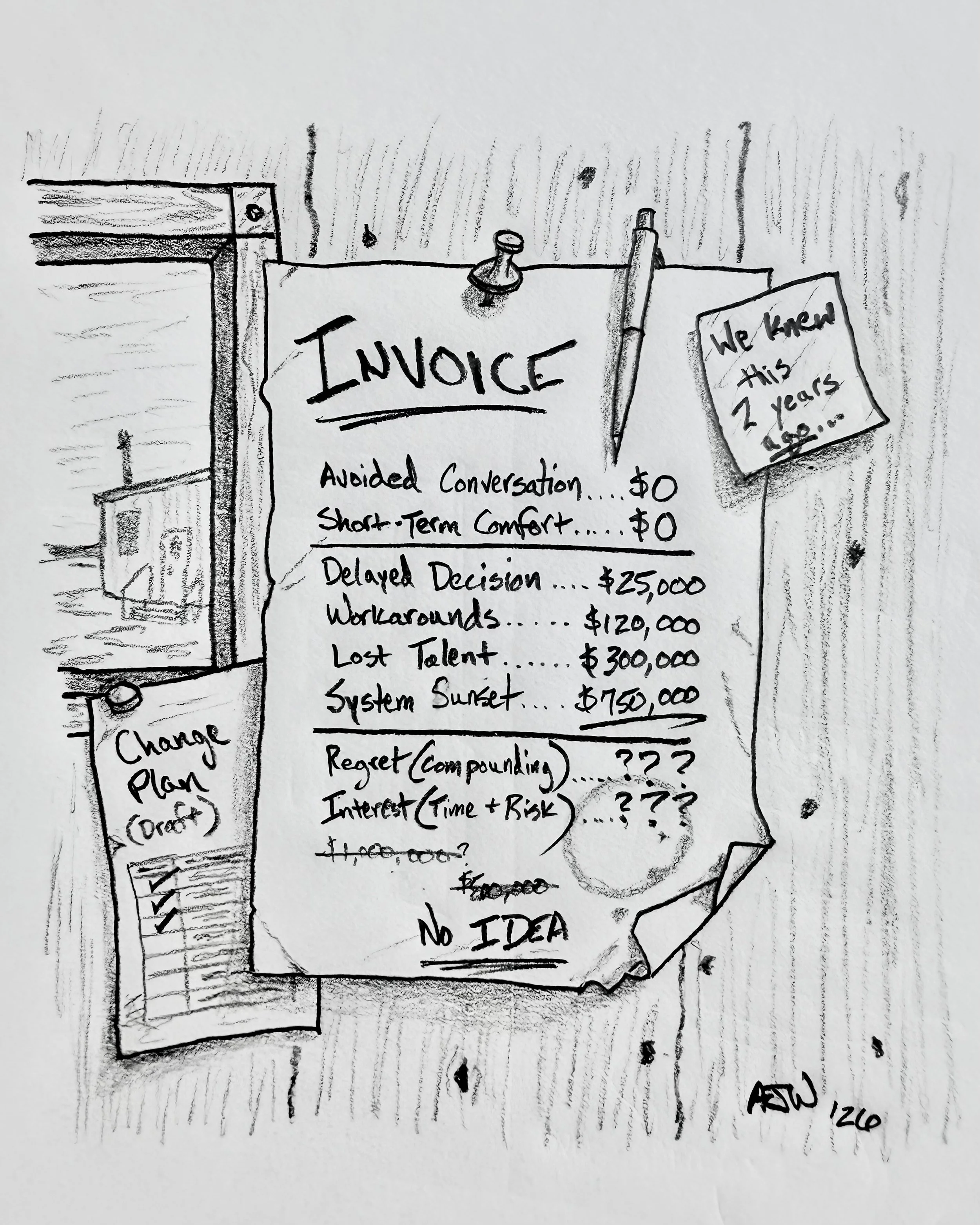
The pain of change is real. It's immediate. It might cost us in the short term. But the pain of not changing is also real, and loves to show up later, with a bigger invoice and interest attached.
Pick your pain. But pick it on purpose.
Construction is cool, tell your friends!