You Are More Than Your Job Title
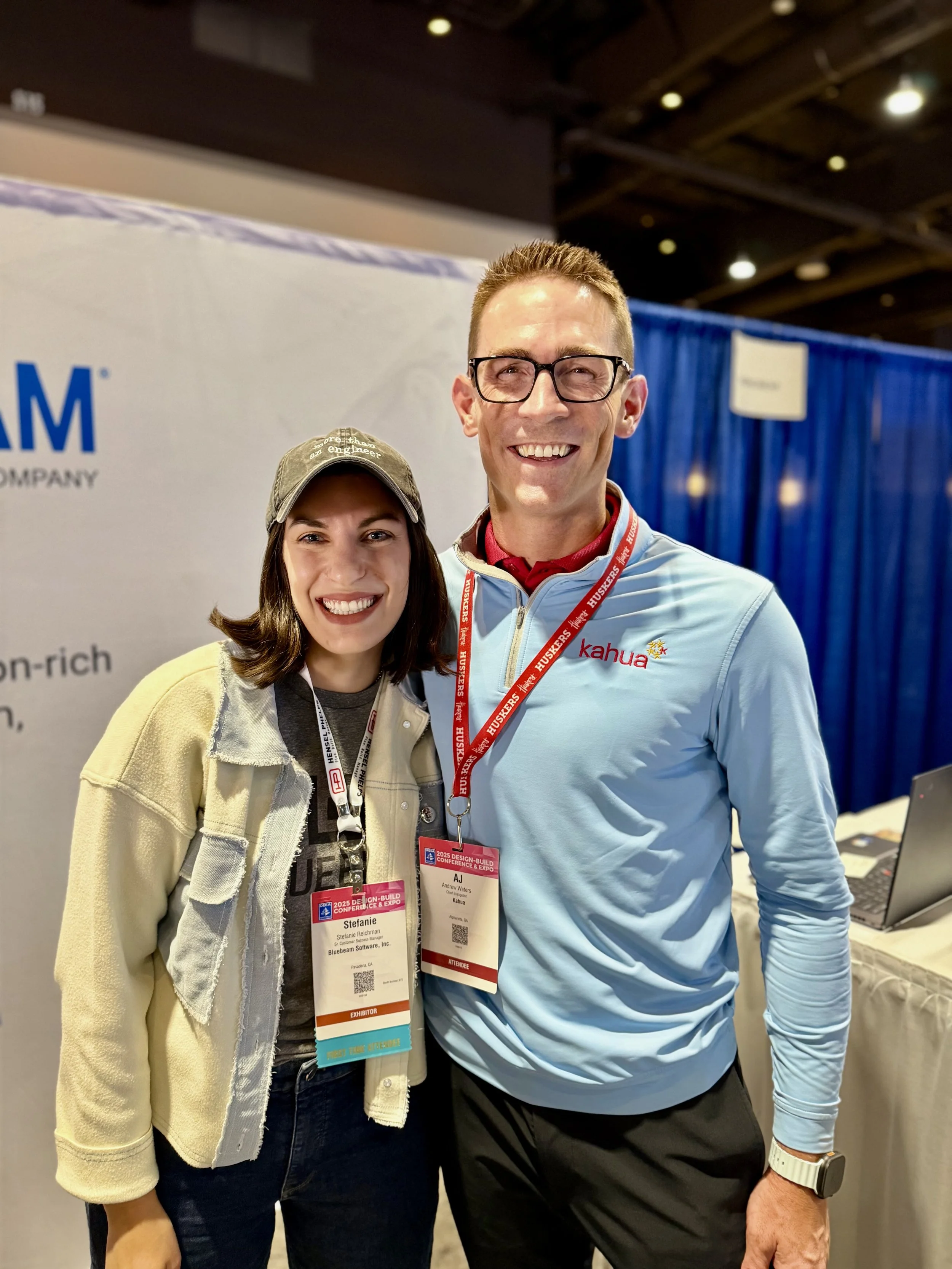
With Stefanie Reichman, November 2025
There is a standard “path” that has been drilled into us kids for decades, often times by our parents.
Pick the major -> Get the job -> Climb the ladder -> Stay in your lane -> Don’t rock the boat.
And if somewhere along the way you feel restless, burned out, or curious about something else, the unspoken message is simple: that’s on you.
That outdated mindset is exactly why I sat down for a conversation with Stefanie Reichman. Stefanie works at Bluebeam, but that’s not why people follow her. They follow her because she’s built a movement around a truth most of us feel but rarely say out loud:
We are more than our job titles. More than an engineer. And no one is handcuffed to a single role for their entire career.
That belief isn’t just her message. It’s her superpower.
When the Ladder Starts Feeling Like a Cage
One of the most powerful parts of Stefanie’s story is that there wasn’t a single dramatic turning point. No explosive resignation. No viral LinkedIn post announcing a reinvention. No overnight transformation.
Instead, there were moments. Small ones. Accumulating over time.
She was finishing her structural engineering degree and realizing that while she had made it to the finish line, she wasn’t convinced the destination was right. She tried roles that were respectable and stable but quietly unfulfilling. She listened to old narratives from teachers and authority figures who hadn’t believed in her early on and didn’t realize how deeply those voices had lodged themselves into her confidence.
That’s the part that resonated with me the most.
Because many of us don’t feel “broken” in our careers. We just feel…off. Like we’re wearing a jacket that technically fits, but never quite settles on our shoulders. And instead of treating that discomfort as information, we treat it as weakness.
Stefanie didn’t. She followed her curiosity, even when it didn’t come with a clear map.
The Real Fear Isn’t Change. It’s Identity
As our conversation unfolded, something became crystal clear. The biggest obstacle engineers face isn’t a lack of opportunity. It’s a deeply ingrained identity problem.
“I’m an engineer.”
“I’m a project manager.”
“I’m a superintendent.”
Those statements start as descriptions. Over time, they become constraints. And while people reach out to Stefanie from two seemingly different directions on the surface, they share the same root.
Some are frozen by fear. They’ve been in a role for years. They feel behind. They hear AI, automation and market shifts closing in. Promotions haven’t materialized. Stability feels thinner by the day. They know something needs to change, but fear keeps them standing still.
Others are trapped in an echo chamber. They’re making career decisions based on secondhand opinions. A friend said tech is better. Someone warned them not to pursue a role without being able to explain why. Advice piles up from people who sound confident but aren’t actually living the life being recommended.
That’s where Stefanie shared one of the simplest and most powerful filters I’ve heard in a long time:
“Don’t take advice from people you wouldn’t trade places with.”
That one sentence cuts through more noise than most career books ever will.
The Stability Myth That Keeps People Stuck
It’s tough, in the volatile economy we live in today, as one of the most honest moments of our conversation centered on stability.
Many people stay where they are not because they’re fulfilled, but because they believe they’re safe. They were taught that loyalty equals security. That staying put is protection.
But the world has changed.
Layoffs don’t discriminate by tenure anymore. “Safe” companies pivot overnight. Entire markets shift faster than career paths can react.
The irony is that the best time to explore your options is when you already have one. Not to quit. Not to panic. But to understand your leverage and your value.
Burnout is often framed as an industry problem. Stefanie sees it differently. More often than not, it’s a misalignment problem. Wrong company. Wrong environment. Wrong expectations.
Sometimes the answer isn’t a dramatic pivot. Sometimes it’s a smart sidestep.
Career Growth Doesn’t Require Burning It All Down
This is where Stefanie’s perspective really stands apart. Career evolution doesn’t have to mean walking away from everything you’ve built. It doesn’t require abandoning construction or starting from zero.
Sometimes growth looks like moving from a massive firm to a mid-sized one. Sometimes it’s shifting from a purely technical role into a business-adjacent seat. Sometimes it’s staying in the same industry but changing how you contribute to it.
Small, intentional moves compound over time. The tragedy isn’t when people make the “wrong” move. It’s when they don’t move at all because they believe the only option is jumping off a cliff.
The Skills Engineers Undervalue the Most
When I asked Stefanie what engineers consistently undervalue about themselves, her answer was immediate.
Problem solving.
Engineers are trained to identify constraints, evaluate trade-offs and work through ambiguity. Companies, at their core, are collections of problems waiting to be solved. Yet somehow, many engineers forget that their most valuable skill travels well beyond reading drawings or running calculations.
The second skill she mentioned was just as important: project thinking.
Engineers already live inside schedules, budgets, risk and scope. They manage themselves against deadlines long before anyone hands them a formal project plan. Transitioning into adjacent roles isn’t a leap into the unknown. It’s often just stepping to the other side of the same coin.
Time and again, she hears engineers say, “I could never do that role,” while actively doing half of it already.
Why This Matters for the Future of Construction
If construction doesn’t create space for people to evolve, we won’t just lose talent to other industries. We’ll lose them to disengagement.
The companies that will thrive over the next decade are the ones willing to have hard conversations, allow non-linear careers and treat people as adaptable assets rather than fixed roles.
The old sink-or-swim mentality might be familiar, but familiarity isn’t the same as effectiveness. The industry can’t afford to keep burning people out and wondering why they leave.
How This Actually Applies at Work
But all of this reflection is meaningless if it stays theoretical.
Applying the “more than an engineer” mindset requires taking action.
Take an honest look in the mirror: Strip away the title and look at the work itself. The problems you solve, the decisions you influence, the constraints you manage. That’s where your real value lives, and it’s usually much broader than you think.
Clarify what’s missing: Restlessness without direction turns into frustration. Restlessness with clarity becomes momentum. Understanding what’s missing (growth, balance, compensation, or exposure) keeps you from chasing someone else’s version of success.
Start small: Career evolution doesn’t start with a resignation letter. It starts with curiosity. Exposure. Side projects. Cross-functional conversations. Adjacent opportunities that let you test assumptions before betting everything.
Have the conversation you’ve been avoiding: Managers aren’t mind readers. A respectful, factual conversation about interests and growth can open doors you didn’t know existed. And even if the answer is no, clarity is still progress.
Be selective about whose voices shape your decisions: Advice is abundant. Wisdom is not. If you wouldn’t trade places with someone, their perspective deserves context, not control.
At the end of the day, ownership is both the scariest and most empowering realization of all. No one else is steering your career. Not your manager. Not your company. Not the industry.
Just you.
Final Thought
You’re not locked into a decision you made years ago. You’re not betraying construction by wanting more. And you’re not weak for feeling restless.
You are more than your job title.
And voices like Stefanie’s matter because they give people permission to say that out loud, and then most importantly, do something about it.
So maybe this week, ask that question. Explore that option. Start that conversation.
Because construction is evolving, and we’d love to keep you evolving with us.
Construction is cool, tell your friends!