The AI Mirror

For twenty years, your data has been a mess. You know it. I know it. Every PM who's ever looked for the final Excel version at 11pm knows it.
But it never really mattered. Because humans were doing the interpretation.
A superintendent could look at a schedule three weeks out of date, a cost report missing two change orders and an RFI log with conflicting status fields and still make a decision. The mess was tolerable because in all reality the mess was invisible. Your people filled the gaps. The estimator squinted at the takeoff. The accountant reconciled from memory.
The entire industry quite literally runs on tribal knowledge layered over top of broken systems.
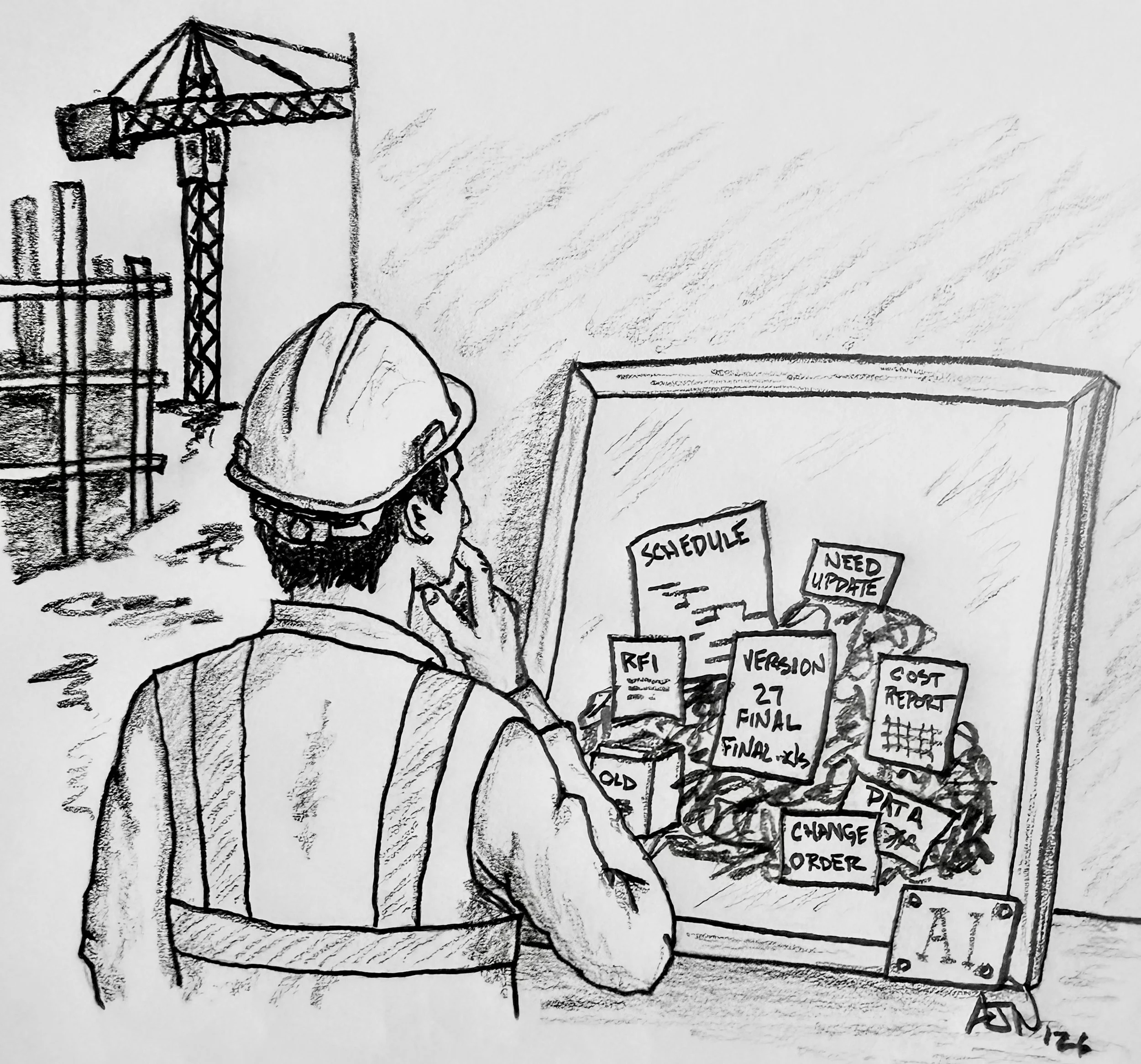
But then AI showed up. It asked to read the data. And all of a sudden, the emperor had no clothes.
AI is a Mirror, Not a Tool
Two new studies just dropped that, taken together, say something the industry has been working very hard not to admit.
First, Dodge surveyed contractors on AI adoption. The headline finding: 92% of contractors using AI for progress tracking prefer it to their old methods. 89% prefer it for subcontractor prequalification. 86% for invitation-to-bid. The numbers are staggering. The people actually using AI absolutely love it.
So why isn't everyone using it?
Because only 26% of contractors rate their data as high quality. 58% admit it has "gaps and inconsistencies." So while contractors with high-quality data report 81% AI effectiveness, those with moderate data drop down to 70%. That 11-point gap isn't about who bought the better AI. It's about who did the work before AI showed up.
Then there’s the Revizto report surveying AEC professionals on AI. 96% of CIOs are concerned about data ownership, leaving their top barrier to getting value from AI not at all about cost. Nor capability either. Rather it’s all about “poor data foundations."
These CIOs are finally saying what some of us have been saying for two years now. The construction industry doesn't have a technology problem.
It has a self-awareness problem.
The Audit You Never Asked For
Consider how we got here for a moment.
For decades, construction technology was sold as a “single source of truth.” Capture the data. Store the data. Pull a report when the job sponsor (or owner) asks. Nobody cared if the data was good, because nobody was actually using it for anything. The "system" was the filing cabinet, for all intents and purposes. Intelligence lived in people's heads.
Then tech platforms began to layer shiny, new tools on top. A best-in-class scheduling app. A best-in-class cost tool. A best-in-class field app. Yet each one still captured its own data, in its own format, in its own silo. The platform “integrations” were lipstick. The dashboards were theater. The single source of truth quickly became a marketing slide, not a technical reality.
But it worked. Sort of. Because humans were still the only loop.
Now we're asking AI to do the interpretation. And AI can't squint. AI can't ask the super what they meant by "almost done." AI can't reconcile two RFI logs by remembering which one Sarah updates and which one Mike ignores. AI reads what's there. Exactly what's there. Nothing more.
So when the majority of contractors say their #1 AI concern is "lack of reliability or accuracy of AI outputs," what they're really saying is: we're nervous about what AI will tell us about ourselves.
The excuses are evaporating. The mirror is getting clearer.
AI didn't create your data problem. AI is just the first system that won't pretend the problem isn't there. It literally doesn’t know how.
The Closed-Platform Denial Mechanism
The real problem is that much of the contech stack available today was designed not to fix this problem, but to hide it. Closed platforms. Proprietary data models. Vendor lock-in dressed up as "integrated solutions." If you can't get your data out, you can't see how bad your data is. If you can't see how bad your data is, you can't fix it. If you can't fix it, you keep paying the vendor.
That model worked great when nobody was trying to do anything intelligent with the data.
Not anymore.
CIOs aren't sitting in their office worried about data ownership because they read a thought leadership post about it. They're worried because they're trying to deploy AI, and they're realizing the data they need is being held hostage by vendors who built the cage on purpose.
“Clients have not focused enough on preparing their data to be accessible for open AI tools to use. You need IT people with data architecture experience and the right platforms, and those are not cheap. You have to invest in building your data sets as data lakes, data warehouses, to really take advantage of the opportunity AI represents," states Erin Roberts of EY.
Translation: the bill for twenty years of "good enough" data hygiene is now due, and it’s being collected by AI. Not by the auditors.
AI is Ready. Are You?
The truth is, the companies winning with AI right now aren't smarter about AI. They've simply been more honest about themselves.
They looked at their data architecture and admitted it was broken. They looked at their tech stack and admitted it was bloated. They looked at their workflows and admitted they were designed for humans to compensate for systems, not for systems to support humans.
Then they went to work fixing it.
They consolidated. They standardized. They invested in data quality before they invested in AI. They picked platforms that gave them ownership of their own information instead of platforms that gave them a prettier dashboard.
That's the difference between those reporting AI effectiveness gains while everyone else feels stuck.
That's why only 19% of contractors are "actively adapting workflows for AI" while more than half continue to be "evaluating."
And that's why the gap between the leaders and the laggards is about to become uncrossable.
You don't have an AI readiness problem. You have a "we've been getting away with it" problem. Now AI is the audit you didn't ask for. It's the mirror that won't lie. It's the consultant that doesn't care about your feelings.
The question is no longer about whether AI is ready for construction. The question is whether you’re ready to look at yourself.
What is the mirror showing you?
Construction is cool, tell your friends!