Subtract First: Why More Tech Is Making Construction Worse, Not Better

What happens when Disney doesn’t approve of your tech demo.
There was a time, in the not-so-distant past, that I was tasked with leading the Center of Excellence for a large GC. Our main challenge: We were struggling with too many disconnected tools, too many manual steps and too many places things could go wrong.
So, like any tech-believers would, we spearheaded the implementation of a brand-new solution that promised to consolidate everything while adding the missing workflows we needed. It was marketed as a configurable “silver bullet” that could replace a variety of old systems.
The future was finally here. Or so we thought...
By the time the dust settled, we still had those same variety of systems, plus the shiny new one. Nothing had been removed. The clutter hadn’t gone away. All it did was grow and disconnect the processes even more.
That was the moment I learned something construction professionals have known in their gut for years: adding technology doesn’t automatically make us better.
Sometimes more is truly just…more.
Tech Investment is Exploding, But Productivity is Stagnant
The irony is that construction isn’t under-tooled. We’re overloaded. Our industry has more digital platforms and “smart” solutions than ever before and yet productivity has barely moved in decades.
McKinsey reports that global construction productivity has grown only about 1% per year (a quarter of the rate seen in manufacturing) even as billions have been invested in digital transformation and new tools.
If technology alone were the answer, we’d be delivering every project faster and cheaper by now. But the reality is instead of eliminating many of our inefficiencies, we’ve simply just digitized them. We’ve paved cow paths with software instead of building highways to new ways of working.
The Hidden Burden of Too Many Tools
And the weight of all that technology is starting to show.
There is a growing recognition across the industry that tool-stack fatigue is slowing projects down rather than speeding them up. When teams must juggle multiple apps that each solve a sliver of the problem, workflows fracture. Instead of a single source of truth, we create multiple sources of confusion.
Industry experts are sounding the alarm: complexity, duplicated effort and overlapping capabilities are now major contributors to delays and frustration on projects. Even the tools marketed as “easy to adopt” still carry hidden burdens such as added configuration, additional training and continuous updates and maintenance.
All of this compounds into additional mental overhead, each one becoming a small tax that chips away at the time and attention a builder needs to keep people safe and keep work moving.
And research shows we have not been nearly honest enough about these hidden costs. A recent review of digital infrastructure programs identified 74 distinct barriers to successful tech adoption in construction, most tied not to the technology itself but to the friction it introduces: poor alignment with workflows, steep learning curves, resistance from experienced teams and systems that disrupt existing communication instead of improving it.
These are not “bugs” in the system. They are the consequences of assuming that additional capabilities must always lead to additional value. They don’t.
And finally, there’s the elephant in the data room: interoperability. One of the most expensive challenges in construction is the inability for systems to talk to one another, forcing manual re-entry, introducing additional errors and creating silos that bury critical information.
Multiple studies estimate that poor interoperability costs the U.S. capital-facilities industry an additional 2-4% of the project cost every year. What’s worse, that estimate dates back to a time when we had far fewer systems in play than we do today. We keep adding new layers in hopes one will finally become the “platform of platforms,” but each layer only adds another interface someone must translate.
What the Field Really Wants from Tech
Let’s get human for a second. Walk onto any project and ask a superintendent what they need from technology, and you will never, I repeat never hear, “Man, I just wish I had one more app.”
Your teams in the field want less noise, not more. They want fewer interruptions. They want one clear place to look for the truth. Technology hasn’t failed the field because the tools aren’t capable. It’s failed the field because the tools keep asking them to give way more than they ever get.
Attention is the most valuable currency on a jobsite.
Every extra tap, login and app switch steals that attention away from the work. Attention that ultimately prevents rework, improves quality and protects lives.
Innovation Is Found in Subtraction
Sahil Bloom wrote about how progress in our lives is often less about what we add and more about what we stop tolerating. We tolerate unnecessary approvals. We tolerate duplicate entry that exists only because “that’s how the old system worked.” We tolerate outdated tools because decommissioning them takes courage. We tolerate the drag of inefficiency because addition feels like progress and removal feels like risk.
And so we pile on rather than clean up.
But here’s the shift we need to make with ConTech: innovation is found in subtraction. The discipline to eliminate steps that don’t serve the goal. The courage to retire tools, not deploy more. Innovation is found in the insight that streamlining a workflow can create more measurable ROI than automating a broken one.
And for crying out loud, it’s teaching technology that its highest calling is to just get out of the builder’s way.
When teams do this, when they thoughtfully remove the friction instead of adding more features, adoption skyrockets. Training shrinks. Data becomes visible and useful. Collaboration strengthens. And field leaders stop feeling like part-time software administrators and start feeling like builders again.
These effects aren’t subtle either. Even small reductions in wasted time, confusion or constant switching scale across projects, across companies and across industries. In short, the return on subtraction compounds quickly.
The future of construction technology will not be defined by who can pack the most features into an interface. It will be defined by who can remove the most obstacles from the flow of work. It won’t be the loudest tool in the ; it will be the quietest. The one that blends into the rhythm of building so seamlessly that people forget they’re even using technology.
The truest mark of success for future technology may just be that the tech becomes invisible.
The Question Every Organization Must Ask
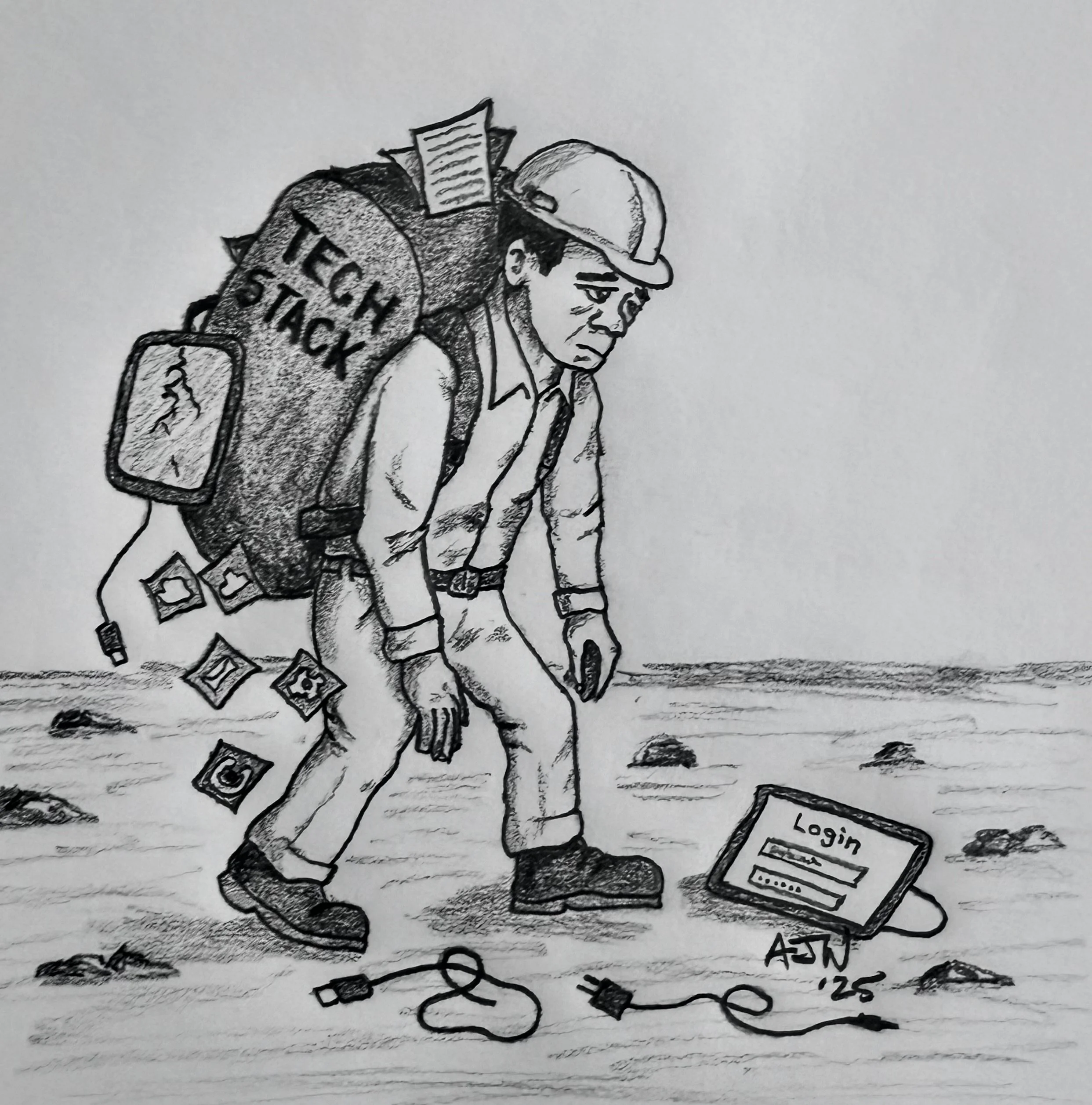
So, before you go out and buy the next platform, before you rush to download the next app, even before you send one more login to the field, why not pause for a second to ask one bold question:
What is slowing us down that we’ve been tolerating for far too long?
From there, start with one workflow and make an effort to remove one step. Analyze the process, the tool and the limitations and see what can be done to reduce effort. Because the path to real transformation might not be in what we add to our tech stack.
Maybe, just maybe, it lies in what we have the conviction to remove from it.
We don’t have a technology adoption problem. We have a technology abandonment problem.
Construction should (and will) always be about building, not about managing technology. And sometimes, the fastest way to build better is to strip away what’s been holding you back to begin with.
Construction is cool, tell your friends!