Construction Doesn’t Hate Innovation. It Hates What Innovation Reveals.
There’s a fantastic scene in Ford v Ferrari that has stuck with me ever since I first watched it. On a recent trip I was watching the movie again and it struck me:, this scene is powerful not because of the racing, but because of the uncomfortable truth it exposes.
To paraphrase, Ken Miles and Carroll Shelby are sitting in a diner talking about what it would mean to work with Ford. Ken isn’t worried about whether Ford can build a fast car. He’s worried they won’t let them build the right car. He talks about layers upon layers of people whose entire job is pleasing the person above them. Not bad people. Not dumb people. Just people trapped inside a system that rewards obedience and punishes difference. And he sums it up perfectly in one statement:
“Deep down, who they hate even more are guys like you. Because you’re not like them. Because you don’t think like them. Because you’re different.”
Ken isn’t afraid of failure. He’s afraid of success that protects the machine instead of the mission. That scene isn’t about racing at all. It’s about bureaucracy. And every time I see it, I’m reminded just how closely it mirrors what we’ve normalized in construction.
We Don’t Hate Innovation. We Hate the Mirror
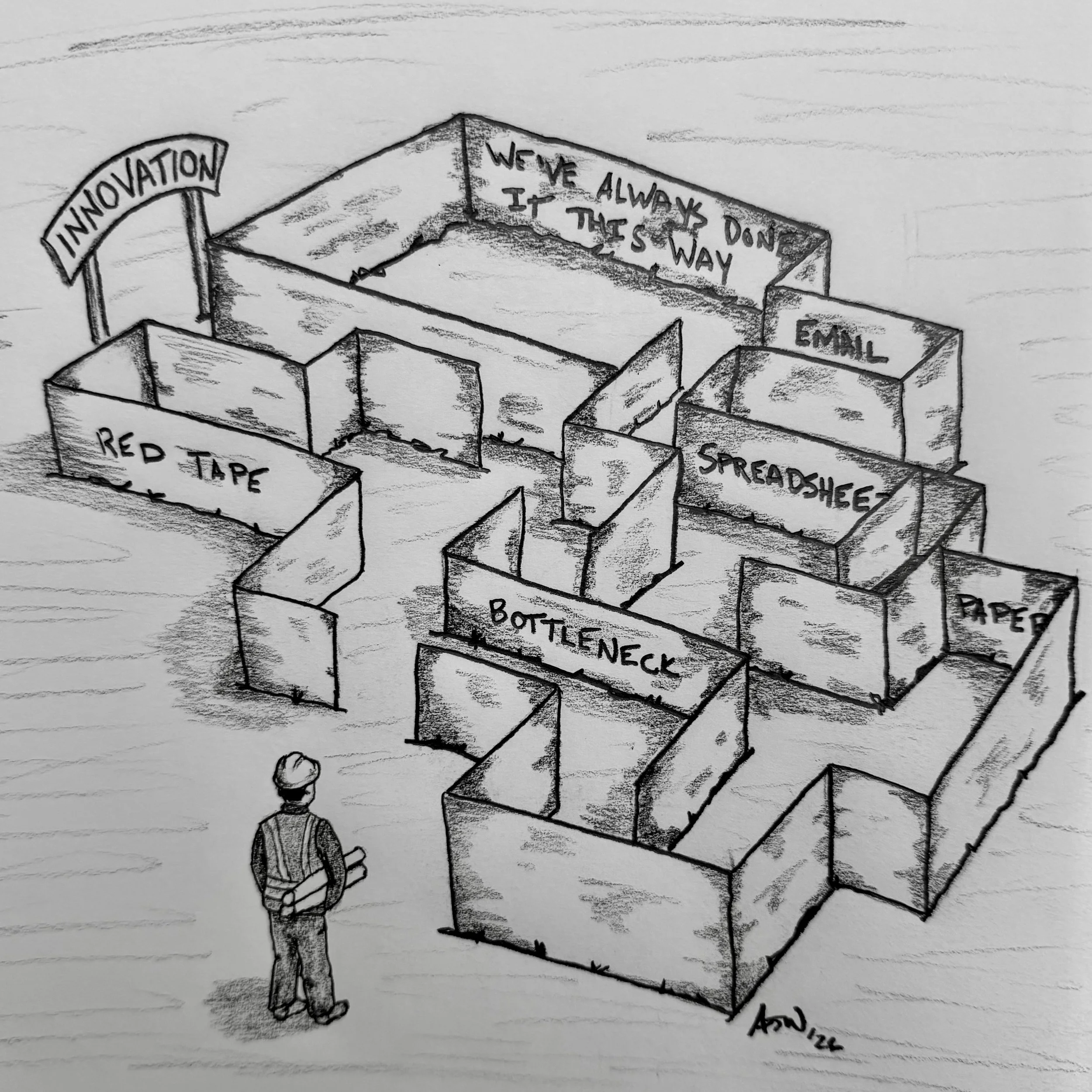
We like to say construction resists innovation because it’s old-fashioned, risk-averse or slow to change. Personally, I don’t think that’s true. Construction doesn’t hate innovation. It hates what innovation reveals. It exposes inefficiencies. It challenges power structures. It forces truly difficult questions around why things are the way they are and who benefits from that reality.
Bureaucracy doesn’t kill innovation accidentally. It kills it to protect itself.
When innovation threatens comfort, predictability or hard-earned authority, the immune system kicks in. Meetings multiply. Concerns get raised. Exceptions get carved out. And eventually, the idea dies quietly, not because it was wrong, but because it was inconvenient.
The Firefighter Fallacy in Construction Leadership
You can see this most clearly in who we choose to celebrate and promote. Every organization has that project manager who’s always “in the fire.” The one sending emails at midnight, hopping from crisis to crisis, calm under pressure, heroic in the chaos. They’re praised for their grit and resilience as they rescue their project from what appeared to be certain doom and come out on top.
They’re seen as indispensable. And more often than not, they’re the ones who move up.
Then there’s another type of project manager. The one who builds discipline and systems. Who values people and collaboration, creating clear workflows and predictable handoffs. Who connects data early, surfaces issues before they explode and quietly removes friction. For this project manager, the typical problems never become emergencies in the first place. There are no war stories, simply results. And somehow, they’re overlooked.
The truth is that chaos creates visibility. Prevention creates silence. And in an industry that still confuses chaos and busyness with value, silence is often mistaken for a lack of hard work.
When Construction Technology Preserves the Problem
But it’s not just in leadership. This same dynamic shows up in construction technology. It shows up when instead of challenging broken processes, software simply digitizes them as-is. They preserved old approval chains, encoded outdated thinking.
Technology sometimes just gives us faster ways to do the same inefficient things.
We didn’t modernize workflows. We fossilized them and put them behind login screens.
If your technology still requires heroics to succeed, it’s not innovation. It’s just better-dressed dysfunction. And the people most threatened by better systems are often the ones who’ve learned how to survive the old ones.
Believe me, I learned this lesson the hard way.
Working as a subject matter expert on my first digital transformation, we evaluated and selected an estimating system lightyears ahead of what was being used at the time. It created a real opportunity to consolidate countless side spreadsheets and fragmented estimates into a single collaborative environment. One estimate. One source of truth. Fewer errors. Better organization. Massive time savings.
Seems like an obvious win, right? Not just a better tool, but a fundamentally better way to work.
Well, senior leaders saw it differently. They argued the system “wasn’t built for them.” Their work was too unique. Too complex. Too different. And instead of embracing the opportunity to evolve, they fought to keep the old platform in place (for years), preferring double work and parallel systems over consolidation and change.
In the end, they got their way. Not because they were right. Because they were comfortable. Because they had mastered the old system. Because changing tools would have required changing identity. That experience taught me a valuable lesson: The biggest threat to innovation isn’t bad technology, it’s people who benefit from the way things are broken.
Why Different Thinkers Struggle in Construction
The tension always seems to show up around the same kind of people. The people who ask “why” instead of just “how.” The ones who push for fewer tools instead of more. Who want ownership of data instead of workarounds. Who build systems instead of coping mechanisms.
They’re labeled different. Unrealistic. Not team players.
But what they’re really doing is exposing how unnecessary the chaos is. And when chaos disappears, so does false heroism. So does gatekeeping. So does positional power.
Innovation doesn’t just change workflows. It changes who matters. And that’s why it’s resisted so fiercely.
It’s funny. We talk a lot about labor shortages, burnout and the next generation. We advertise we promote sustainability, balance and smarter ways of working. Then we turn around and elevate the most exhausted person in the room calling it leadership. We tell young professionals this industry rewards grit, but what they see is it rewards suffering.
And then, we act surprised when they walk away.
A Wakeup Call for Leadership
So, here’s the challenge for us all.
Who do you promote? The person who’s always fighting fires, or the one who designed the system that keeps the fires from starting in the first place?
Who do you listen to? The loudest voice in the crisis, or the calm one asking why the crisis existed to begin with? Who makes you uncomfortable in meetings?
Because that person might just be your Ken Miles, your next great leader.
If your best project leaders are invisible because their systems work, your culture is broken. And if a guy like Ken Miles scares you, you’re probably building the wrong car. Construction doesn’t need louder heroes. It needs braver leaders. Leaders willing to reward prevention over performance theater. Leaders willing to let innovation reveal the difficult truths of the old way and act on them anyway.
Because if we keep protecting the machine, we’ll keep losing the race.
Construction is cool, tell your friends!