At What Point Does “Best Practice” Become “We’ve Always Done It That Way”?

“It’s a best practice.”
My, how we love that phrase in construction.
I can still remember the first time I heard it. I was an intern, working on the estimate for a large power plant. Tasked with concrete takeoff, I dove into the drawings with colored pencils and a calculator (yup, hand calcs). As we began to enter my results into the main estimate, the engineer stopped me quick to add 5% to all my numbers. For a new guy, that was an odd request. So naturally, I asked why.
“It’s best practice to include 5% waste on concrete.”
The answer came back fast and confident, conversation over. Not in a rude way. No, it was more like a simple fact delivered with a sort of professional pride.
And at the time, I accepted it and my guess is you would have too. Because when you’re early in your career, you assume “best practice” means someone smarter than you already thought this through.
There are many iterations of this phrase, best practice, industry standard or (my personal favorite) industry best practice. But also, this phrase has a secret evil twin we like to pretend isn’t there.
If the idea of “best practice” is meant to end the questioning, at what point does best practice simply become an excuse for “we’ve always done it that way”?
The Comfort of the Canon
Construction loves its canon.
Standard details. Standard contracts. Standard workflows. Standard ways of estimating, tracking, reporting, approving and communicating. And much of that standardization exists for good reasons.
Safety, for one, has a robust set of standards specifically designed so that people come home to their families each day. Another is risk management where a detailed set of standards is fueled by a collection of lessons learned the hard way.
But at some point, the practices that once seemed innovative harden into doctrine. They stop being best practices and start becoming safe practices. Familiar. Defensible. Unquestioned.
And once that happens, “industry best practice” begins to quickly teeter on the edge of the most dangerous phrase in business: “We’ve always done it that way.”
No malice required. No villain in the story.
Just an automatic response we don’t think to question.
When Best Practices Stop Asking “Why”
Fast forward a few years. I’d moved on from being an intern and deeper into preconstruction where we eventually began deploying better technology. As a younger member of the team, I was now the one helping define processes instead of just following them.
That’s when I started noticing a pattern.
Whenever an estimating practice felt inefficient, brittle or even a little disconnected from how work was actually happening in the field, the justification was rarely technical.
It was cultural.
“That’s how the owner expects to see it.”
“That’s where we always carry those numbers.”
“That’s best practice.”
But when you peeled back the layers with a simple follow up as to why that practice existed in the first place, things got interesting. A logical answer always seemed to surface…that was logical 10 to 15 years ago.
A monthly report existed because data had to be manually complied.
A multi-step approval process with gate checks because information was siloed.
A duplicate spreadsheet was exported because that was the “real” forecast.
But in reality, the logic had changed. The tools were different. The data was there. The field had adapted faster than the processes.
Yet the best practice remained.
Not because it still produced better outcomes, but because no one wanted to be the person who asked whether it still made sense.
The Hidden Cost of Unquestioned Practices
Here’s the part that makes this more than philosophical.
When an “industry best practice” goes unquestioned, every technology provider out there replicates it in their software. Not because it’s optimal, but because it’s expected. This not only stifles innovation, it removes differentiation.
And that creates very real costs.
It creates rework because data is re-entered instead of shared.
It creates mistrust because transparency is filtered through PDFs.
It creates burnout because people spend their days feeding processes instead of solving problems.
It creates false confidence because reports look clean even when reality isn’t.
And worst of all, it teaches the next generation that success in construction comes from compliance, not curiosity.
All of that should scare us.
How It All Finally Clicked
This became painfully obvious a few years ago when I burnt out trying to prove that the industry best practices we’d built into the software were truly “best.”
After walking into several capital program environments where the technology adaptability, data expectations and operating cadence were fundamentally different from what I’d seen before, it hit me. The construction wasn’t different, but the requirements were.
No need for an army of people tracking every detail of every widget on the project. No week-long episode of report reconciliation through checks, balances, rebalances and then rechecks.
And what struck me most wasn’t the processes themselves. It was how often someone would say: “Help me understand why this step exists.”
Not as an accusation. As a genuine question.
All of a sudden, the “best practices” I had grown up with had been thrown out the window. Many of them served as extra fat that wasn’t needed at this new level of project management. Or worse yet, as handcuffs slowing teams down as we attempted to force them into our system.
And that realization messed me up, in the best possible way.
Because once you see that practices can be individualized, it’s impossible to unsee how many in our industry are inadvertently treated as standard.
The Line We Don’t Know How to Draw
So, here’s the struggle I keep coming back to. At what point does a “best practice” stop protecting us and start limiting us?
It’s tough, because there’s no clean answer. No checklist. No expiration date.
But if we were to take a step back, there are a few warning signs.
When a practice can’t explain itself without referencing tradition.
When deviation is treated as risk rather than learning.
When tools are blamed instead of assumptions.
When “best practice” is invoked to end a discussion instead of deepening it.
That’s usually the line. The line you cross where the next answer to why is “we’ve always done it this way.”
Look, we’re living in a moment where construction is constantly being asked for more. More visibility. More accountability. More speed. And on top of all that, more complexity than ever before.
AI. Analytics. Cybersecurity requirements. Data ownership debates.
None of those challenges will be solved by blindly applying yesterday’s best practices to today’s problems.
But also, that doesn’t mean just throwing them out entirely.
It means taking a minute to finally interrogate them.
The Question I Want Us to Sit With
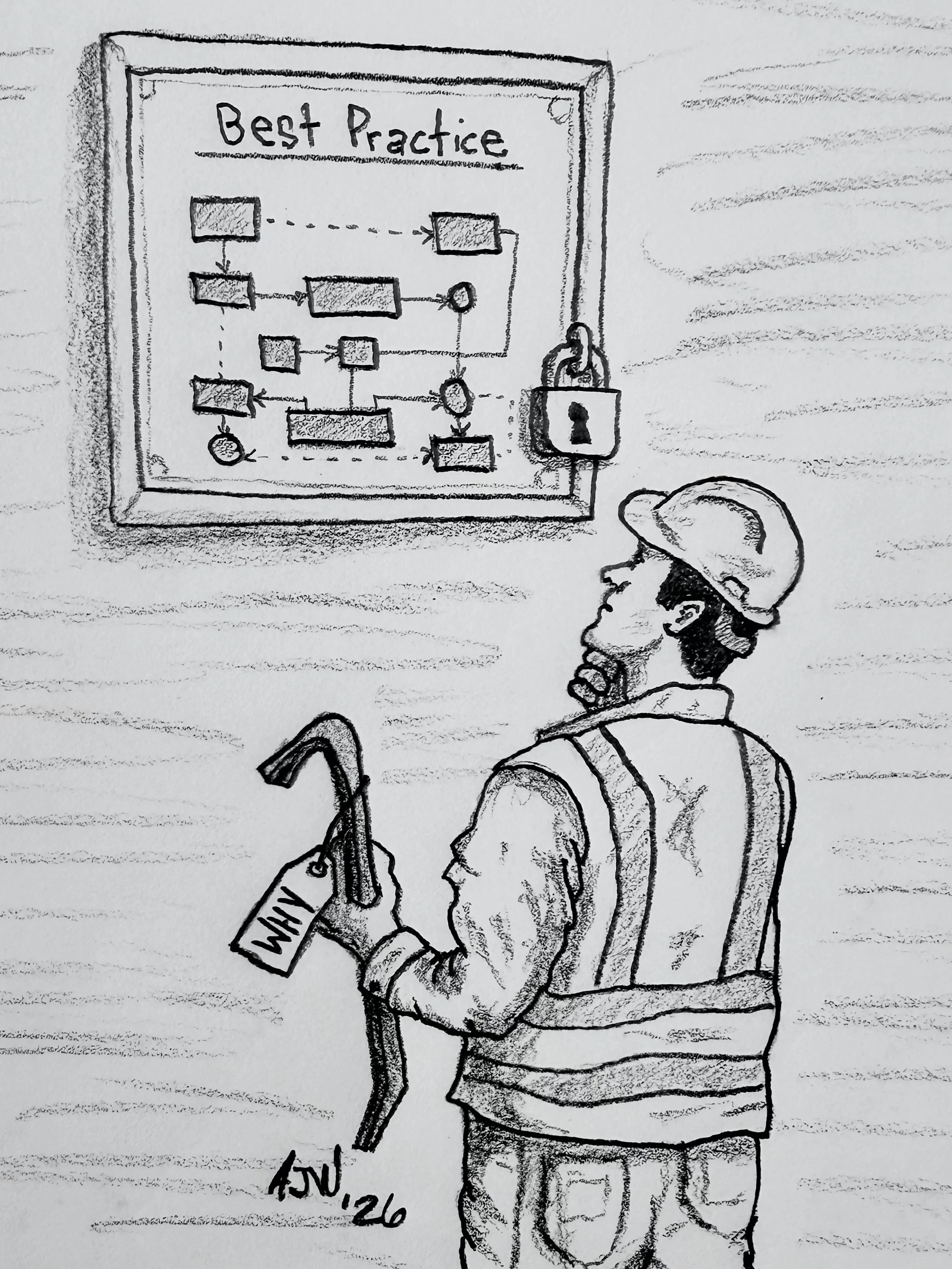
So instead of prescribing answers, I’ll leave you with the same question from the beginning:
At what point does “best practice” become an excuse for “we’ve always done it that way”?
Where might your standards be enforcing comfort instead of clarity? Where might your processes be protecting habits instead of outcomes? Where might your “proven approach” be solving yesterday’s constraints?
If these are questions you’re wrestling with, let me reassure you. You’re not wrong for asking why.
That question isn’t disrespectful.
It’s how progress actually starts.
Construction is cool, tell your friends!