Stop Chasing Tech. Start Building Strategy.

If I were to ask you how many software subscriptions your organization currently paid for, could you answer?
What about how many of those tools talk to each other? How many of your project teams are actually using them consistently? Or the granddaddy of them all, how many of those tools were purchased because someone saw a demo at a conference and got excited?
If those questions are difficult and a little tough for you to answer honestly, then good. That's sort of the point.
And the truth is, you’re not alone. This is an industry-wide problem that many are ashamed to admit. You see, construction doesn't have a tech problem. It has a strategy problem.
And no amount of new AI-powered software is going to fix that.
Feels Like Déjà Vu
If you've been around construction technology long enough, you've seen this movie before. It started with the promise of BIM. Then it grew exponentially with mobile platforms. You can insert drones and wearables and digital twins, but the cycle is always the same.
A new technology emerges with impressive demos and compelling case studies. The vendors hit the conference circuit, get executives all excited and pilots follow. But somewhere between the kickoff call and month six, the wheels come off.
Not because the tech was necessarily bad. But because we keep skipping the hard part.
We adopt tools without designing the system those tools would live inside. We buy software before we understand our workflows. We chase the shiny object before we build the foundation.
And now, with AI, we're doing it again. Only this time it’s faster and with much higher stakes.
Look, AI isn't magic. As I've said before, it's math. It learns patterns from data and uses those patterns to produce outputs. And if the data you're feeding it is fragmented, inconsistent or locked inside disconnected platforms, your AI won't produce insight. It'll produce confident nonsense. Faster than ever, with citations.
The problem was never the tool. The problem was what we built underneath it.
Like Construction, Tech Begins with a Foundation
It still baffles me sometimes that construction professionals refuse to talk about a digital foundation. It is literally required for everything we build. And that’s where the real conversation has to start, with data architecture.
Not the most glamorous topic, I get it. But if you want solutions like AI to actually work on your projects, you must first be honest about the state of your data. And for most of us, that state is not good.
Cost data lives in one system. Schedule data lives in another. Field logs in a third. Documents in a fourth. And all the while, somewhere in the background, there are spreadsheets stitching it altogether.
The statistic is now infamous, how 96% of data collected during construction goes unused. But have you really let that one sink in? We are collecting extraordinary amounts of information on every project, and we are throwing away nearly all of it. Not because we mean to. Because we never designed a system to connect and actually use it.
That's the foundation AI needs to stand on. And right now, for most firms, that foundation doesn't exist.
Before you buy an AI platform, before you sign another vendor contract, before you launch another pilot program, just ask yourself one question. Is my data ready to be intelligent? Do I have a clear picture of where project data lives, how it flows between systems, who owns it and how it gets used after a project closes out? (ok, that’s two)
If you can't answer those questions clearly, no AI tool is going to save you. It's simply going to amplify the mess you already have.
Fixing this is tedious work. It means making deliberate decisions about data standards, system architecture and information governance. It means deciding, as an organization, what your data strategy truly is before you decide what technology supports it. That's the hard work.
Yet it's exactly the work most people skip.
On a More Serious Note, Security
Believe it or not, there’s a second (and even more important) foundational topic most of us seem to gloss over. Data security.
When your teams start pushing project data, contract language, client information and proprietary processes into AI platforms, the risk surface grows exponentially. And in most construction companies, nobody has defined the necessary guardrails.
Which platforms are approved for project data? What information should never leave your primary systems? Who owns the outputs an AI generates from your data? Is your project data being used to train public models that serve your competitors?
Have you even checked if your contracts with AI vendors even address any of these questions?
Those aren't theoretical concerns. There are real examples of sensitive project data ending up in places it was never supposed to go, simply because a team member connected a convenient tool to their project files without thinking through the implications. In construction, where project data routinely includes proprietary means and methods, owner financials, subcontractor pricing and sensitive site information, the exposure is significant.
But don’t get me wrong, this is not a reason to avoid AI.
It's merely a reason to approach it with a strategy instead of just enthusiasm. Security must be part of how you evaluate, select and govern every tool in your technology ecosystem. Full stop. Not an afterthought. And certainly not something you figure out after the contract is signed.
Tech Strategy Looks Different Than Most Firms Think
When we talk about a tech strategy, AI or otherwise, we’re not talking about a 40-page document that lives in a SharePoint folder nobody visits. We’re talking about a set of clear, deliberate answers to questions your organization should already be asking.
Where does something like AI belong in our workflows? Not everywhere. Not in a spray-and-pray pilot across every department at once. Let’s be specific, with specific places and specific use cases, where the value is clear and the data is ready.
What information should flow between our platforms? This is a data architecture question disguised as a technology question. The answer should shape every tool decision that follows.
How do we protect what's sensitive? Before any tool goes live, there needs to be a clear policy on what data can and cannot enter that system, and who is accountable for enforcing it.
What does success for this solution actually look like? Not "we launched the pilot." Not "adoption is up." Real outcomes, like cost impact, improved schedule performance and risk reduction. Time saved on tasks that were pulling your best people away from higher-value work.
The firms that can answer these questions clearly, and first, are operating on a different level. Not because they found better tools. Because they built a better foundation for tools to operate on top of.
The Real Competitive Advantage
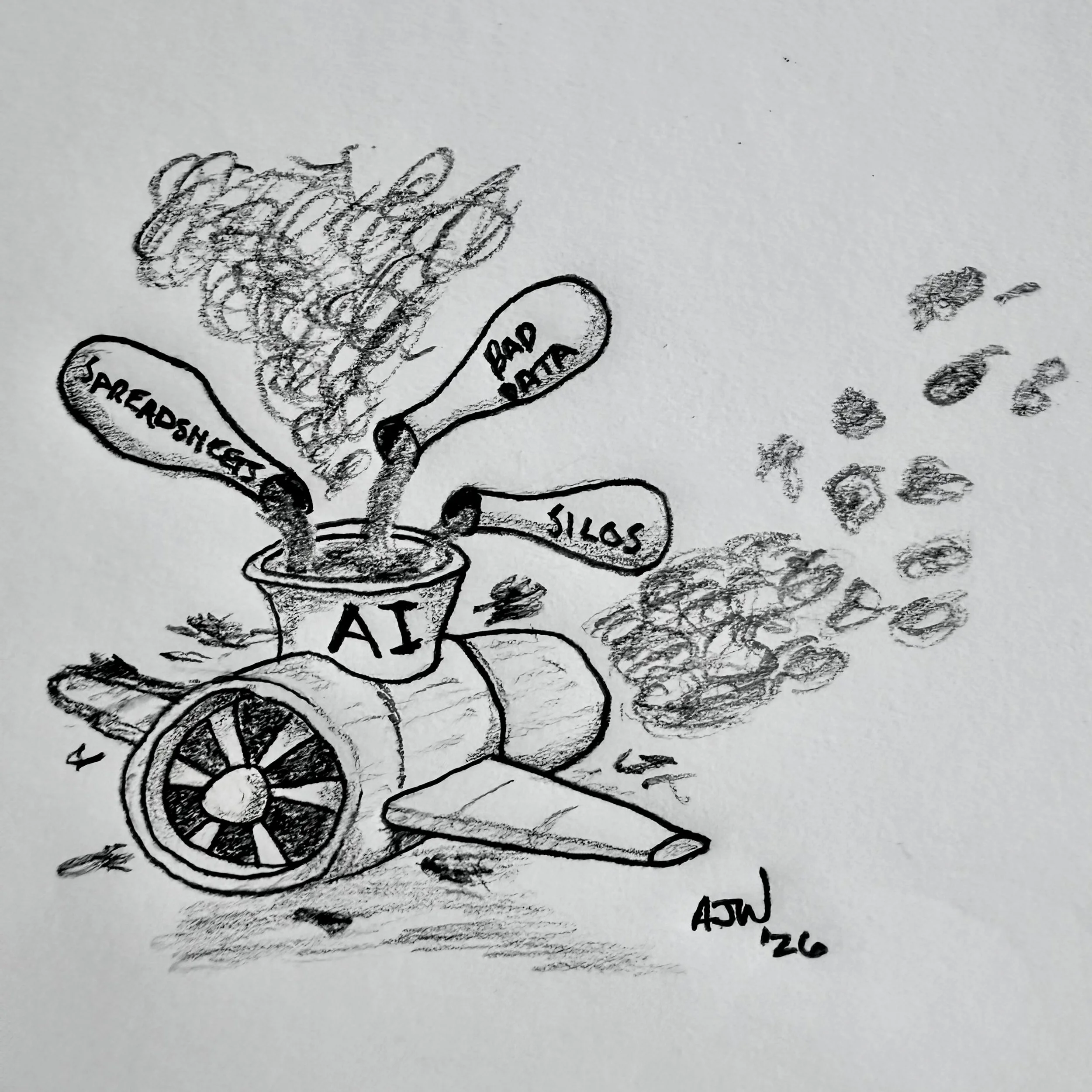
In construction, I believe a true technology strategy is the real competitive advantage.
The tools? They’re just the materials.
Your competitors have access to the same tech options you do. They're seeing the same demos. They're getting pitched by the same vendors. The tool itself is not your edge.
Your edge is knowing which tools belong in your workflow, how your data should support them, how your people will actually use them and how to protect the organization while you scale. That's not something any vendor can hand you. That's organizational discipline. And right now, it's genuinely rare.
The firms that are pulling ahead are not the ones who moved fastest to adopt AI. They're the ones who slowed down long enough to ask the right questions first. They designed their technology strategy the way a great builder designs a structure, with intention, a clear understanding of what's foundational and the discipline to not skip the past it all just because it's invisible when the building is done.
We have the tools. What we need is the strategy to make them mean something.
Construction is cool, tell your friends.