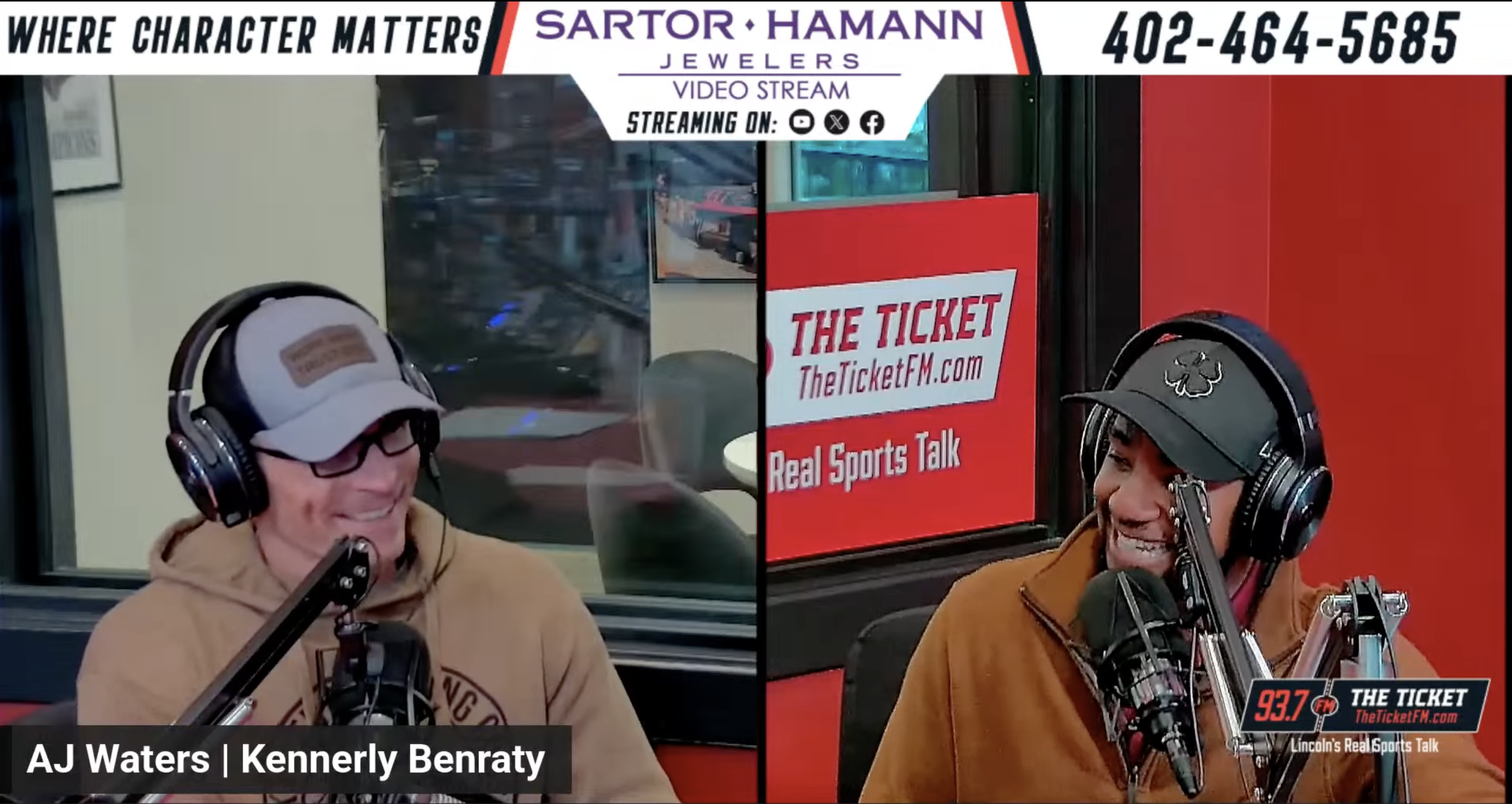
Where Character Matters
The podcast took a the off, so we changed up who was in the hot seat.
It was a real honor to join Kennerly Benraty on his live radio show, Where Character Matters, which aired over the weekend on 93.7 The Ticket out of Lincoln. The show is built on the idea that leadership is less about what you do and more about the journey it took to become the person doing it.
Titles change and the tools come and go, but the person you’re becoming shows up on every project.

Leaders Carry the Weather
Every jobsite has it’s own weather system, yet many of us don’t even realize it. The superintendent shows up hot. The PM who walks in steady. Either can bring the storm, or bring the calm.
So while construction spends a fortune forecasting rain delays, we totally misses forecasting the storm we bring in ourselves.
That’s where Eli Embleton comes in, a man with the unique ability to stay calm under the most extreme pressures. He uses that power to help others move beyond survival mode and into connection.
But in order to do so, he first had to learn to do it for himself.

Garbage In, Sugar Cookies Out
The six most expensive words in business are “we’ve always done it that way.” But for construction, that’s just a Tuesday. And all too often it’s our go-to response for shutting down any conversation about change before it starts.
For someone like Orion, who comes to construction from the outside with genuine curiosity and a unique perspective on data, that answer just doesn’t cut it. Not when we have pigsties of data wrought with hidden variables.
You see, despite the fact construction has survived centuries behind the curve of tech adoption, change is coming.
And it’s coming whether we like it or not.

The Number for What?
Long before Lillie Maximo knew what an estimator was, she knew what one sounded like. Or at the very least, what the superintendents thought of them.
Live from the ASPE Summit 2026 in Orlando, Florida, she sat down to share the stories of that first-hand experience. Experience she puts to use for good by taking complex project information and finding the real story behind the number.
Because it’s that story where most estimates can easily go wrong.

The Expertise You Need Is Already in the Room
There's a side of construction that still seems to believe the biggest gaps we face on the jobsite are technical.
Missing software. Missing integrations. Missing data.
But the gap is so much simpler than that. Before we even get to the captured data, there’s a plethora of expertise sitting in someone's head that somehow never makes it into the conversation.
And how we close that gap just might be the most important innovation of all.

When Nothing Happens Equals Job Well Done
Nobody walks into a building and checks whether it's going to fall down. We just trust that the building will stand there as intended. And the moment you stop noticing a system altogether is a system doing its job perfectly.
That's the trap of anything that actually works. But the invisibility of effort isn't the same as the absence of effort.
So how can an entire organization, made up of 70,000+ members, build themselves around a definition of success that looks like nothing at all?

The Grain Doesn’t Lie
When it comes to art, and the idea of molding stellar creations out your material of choice, there is one common skill that each great builder has.
Patience.
Whether wood or metal, acrylic or oil, every great artist has patience. But we’re not talking about the passive kind. We’re talking about the kind that builds projects people love and cherish for years to come.
Believe it or not, we can learn from this kind of patience. And what we can learn is a lesson construction has desperately needed.

We’re Actually on the Same Side
In construction, the contract has become a secret weapon. Yet while it’s a system designed to pit us against each other, that doesn't have to mean we have to be adversaries.
Instead, when you approach a redline from the place of a shared end goal (completing the project), negotiations stop feeling like an attack. They’re simply two people trying to accomplish the same thing, faster and with less pain.
It sounds super simple, right? So why is it almost never how things actually play out?

Profitable on Paper, Broke in Practice
Your P&L says you made money last year, but for some reason it doesn’t feel like it. That’s because you’re looking at the wrong number. Revenue.
Here’s the thing, revenue is not health. In fact, it never was.
So that number you're proudest of might just be the least real number in your books.

The Wrong Battle
We keep asking the wrong question about AI in construction, who wins and who gets replaced.
And funny enough, it seems we’re all building our AI adoption strategies around that specific belief. However, when you talk to Girish Bhatia, founder of ConstructMind.AI, he will tell you that this is the wrong belief.
You see, the thing is, it was never really about us versus them to begin with.

Trust Has No Neutral Transactions
There's a lie that runs across many construction sites, and it goes a little something like this: "It’s not a big deal."
Whether it be the missed callback or the days-late follow up, we all too often ourselves those things are trivial. That people don't even notice.
Well, they notice.
That’s why Joel Bennett set out on a mission to teach leaders in construction a unique skill. How to actually operationalize trust.

The Tool Isn’t Impressive, Trust Is
Which matters more, how impressive a tool is or how trustworthy it is? When I sat down with Brian Tracy, who literally co-authored the textbook on managing construction technology, his answer certainly caught me off guard.
“A tool is impressive to me by how trustworthy it is.”
Maybe that’s cheating, but honestly he’s not wrong. And the more you dig in, the more you realize that’s how we constantly miss the point with contech.

The Safety Net is the Saboteur
Four out of five digital transformations fail. That's an 80% strikeout rate which, even in baseball, isn’t very good at all.
And of course, we just love to blame that on the software. The clunky, broken, overpromised software. I get it, sometimes that might be true. But after twenty years of ConTech, it’s become clear that failure is rarely about the tool and more about the back door we leave open.
But don’t just take my word for it. Take from the guy who literally wrote the book on implementation.

You’re Not Hiring Talent. You’re Building a Coaching Tree
Construction doesn't have a talent shortage. It has a coaching tree shortage.
A shortage is something you fix with better recruiting. A tree is something you can only solve with intentional decisions compounded over years.
The challenge for construction right now is nearly half the workforce will retire in the next five years. That means we’re about to quickly learn who built trees and who just built rosters.

The Question That Changes Construction
There’s something ironic about calling Tyler Campbell’s superpower “listening.” If you’ve ever tuned into his podcast, you’ve picked up on his energetic, opinionated and quick-witted charm.
What you may not expect though is while Tyler may have started out as a listener to the industry, there was a point in time where he lost his edge. Behind all that boldness lies a superpower forged through failure, ego checks and a few lessons in humility.
Like the realization of just how little he actually knew.

Processes First, Tech Second
There’s a subtle frustration humming beneath the surface of our industry.
We have more technology than ever. More dashboards. More integrations. More AI pilots. More digital transformation initiatives with glossy slide decks and bold promises.
But if we truly want better outcomes, we have to fix the way we work.

Risk for the Rest of Us
Every so often, you meet someone whose impact on the industry doesn’t come from inventing a shiny new tool or shouting the loudest on a stage. It comes from taking something we as an industry have collectively overcomplicated and calmly returning it to common sense.
Tom has the unique ability to take one of the most intimidating, jargon-heavy topics in construction and strip it down to the point that the rest of us can actually use it.
That topic is risk.
But his simplified perspective didn’t come from new theory. It came from failure.

We Can’t Build Anything Worthwhile If We’re Busy Fighting Each Other
I’ve spent my entire career in and around construction and if there’s one thing every jobsite has taught me, it’s this: We are really, really good at fighting.
Unfortunately, I don’t mean a healthy debate. I mean real fighting. The kind where we draw battle lines and weaponize RFIs.
I get it, the stakes in construction aren’t theoretical and somewhere along the way we convinced ourselves that survival requires being on constant defense.
But you can’t build anything meaningful with clenched fists. And in this week where we focus on giving thanks, that truth is becoming harder to ignore.

Why We Still Suck at Managing the Two Most Important Things: Time & Money
There are only two scarcities in life: time and money. And if you mess up one, you’re probably going to lose the other.
Many of us in construction have built careers fighting fires that never should have started. From war rooms full of red dashboards to schedule meetings of wishful thinking, we’ve done everything in our power to hit the deadline in time for opening day.
But only 8.5% of construction projects actually come in on time and on budget. Yup, less than one in ten.
This isn’t just a rough patch; it’s a full-blown industry crisis. Is there any hope for improvement?

Leading Through Chaos: What Construction Can Learn from the Military
It was one of those Mondays. The kind where your phone starts buzzing before your alarm does. By the time I woke up, the daily concrete numbers were off, by a lot, and by lunch we realized there was an entire floor in a multi-story building missing.
In construction, VUCA doesn’t just describe the environment. It describes Monday.
While originally defined by the U.S. Army War College to describe the chaotic conditions of modern warfare, you no longer need a battlefield to feel it. You just need a project under construction.
So how do we lead through it?
