The Bottleneck Was Never the Tools
Why Construction Productivity Remains Flat

For the better part of fifteen years, I have been one of “those people” preaching the gospel of construction technology. Standing in front of rooms full of executives with total conviction, we’ve helped select platforms, lead implementations, break down legacy silos and built new products from scratch. I believed deeply that if we could just get the right technology into the hands of builders, productivity would finally break loose, and the long-flat curve would bend upward.
But it hasn’t.
Over the last two decades, construction management software adoption has exploded. We digitized RFIs, change orders, daily reports, pay apps, submittals and schedules. We moved drawings to the cloud. We connected job sites with tablets. We layered in integrations. Heck, we’ve even piloted AI. Yet, when you zoom out and look at the research on industry-level productivity, the curve hasn’t hockey-sticked.
In many measurements, it has even slightly decreased.
So, let’s be real honest, if technology alone was going to increase construction productivity, we would have seen it in the data by now. We haven’t, which means the bottleneck is bigger than the tools.
The Proof is in the Data
When you examine the productivity data more closely, the picture is nuanced but consistent. Sector-wide measures of construction labor productivity and total factor productivity show long stretches of stagnation compared to the broader economy. Yes, measurement is messy, but this comes as a surprise to no one. We all have seen and understand the data.
But even when researchers account for the ever-changing regulation and growth of the industry, we have not experienced the transformational efficiency gains that were promised during the digital wave. That doesn’t necessarily mean the technology is useless. It means tools don’t beat systems.
We digitized paperwork, but we never truly digitized the production system. And that distinction explains a lot.
But to be clear, this is not an indictment of builders. Construction professionals are some of the hardest working, most adaptive people on the planet. It’s also not an indictment of every technology vendor. Many of them have solved real problems. The issue is structural.
Fragmented contracting structures, rework loops, misaligned incentives, poor handoffs and borrowed data environments consume any efficiency gains before they ever show up in labor trends. We tried to automate complexity without redesigning it. We layered software on top of legacy processes and assumed the interface would fix what the system never addressed.
Where Tech Gets It Wrong
As I’ve said before, there was a time I believed out-of-the-box platforms could deliver 80% of what companies needed for processes. But in many cases, that number is closer to 60%. That missing percentage is not cosmetic. It represents the workflows, nuances and competitive edges that make each organization unique. When we force those into a rigid framework, teams start building workarounds. The side spreadsheet reappears making the temporary process permanent and the system fragmented once again.
And that’s how product roadmaps became innovation bottlenecks. Vendors tried to be everything to everyone, and in doing so hardened into rigidity. Construction, however, is not average. A regional contractor, a specialty trade partner and an owner-led capital program operate differently. When platforms cannot flex, innovation slows and frustration rises.
The problem compounds when we add more technology without taking anything away. Adding tools without simplifying workflows creates cognitive overload. Instead of removing legacy steps, we digitized them. Instead of streamlining reporting, we simply added dashboards. And instead of eliminating friction, we compounded it with more logins and more screens. The end result is tool-stack fatigue, digital silos and teams who fell more like part-time software administrators instead of builders.
We Must Stop Digitizing Complexity
At its core, construction does not fail because people lack effort. It fails when the systems running the work are poorly designed. Strong, simple, repeatable systems drive performance far more reliably than feature-heavy platforms. Technology can amplify a well-designed system. It cannot compensate for a broken one.
Part of the challenge is cultural. We have a tendency to replicate legacy practices in software without questioning whether they still serve us. We configure platforms to match “industry standards” that may have been designed for a different era. We carry forward approval chains that existed because data used to be hard to access. We preserve reporting rituals that were born in fax machine days. Then we wonder why digitized inefficiency still feels inefficient.
Even AI, the current headliner, is not immune to this trap. AI amplifies whatever foundation you give it. If your workflows are undefined and your data fragmented, AI scales chaos. The same has been true for every wave of ConTech over the last twenty years. We attempted to automate ambiguity instead of clarifying it.
And truly, I had to change my own thinking on a lot of this. I held a strong opinion that more advanced technology would inevitably drive productivity. The data forced me to loosen that grip. The issue was not a lack of software sophistication. It was a lack of systemic alignment.
The Platform Inflection Point
So where does that leave us? It leaves us at a turning point.
The out-of-the-box, one-sized-fits-all platform fallacy has officially run its course, making the age-old debate of build versus buy insufficient. Buying rigid, off-the-shelf tools leads to significant compromise and side systems. However, building custom systems from scratch leads to its own compromise through heavy maintenance burdens and security risks.
Luckily, a third path has emerged in Platform as a Service. A stable, secure foundation handles hosting, compliance and core capabilities. On top of that, organizations configure and extend workflows to match how they actually build.
This flexibility matters because productivity improvements do not happen at the macro level first. They occur in the micro. They happen when a handoff is clarified and rework drops. They happen when data flows without re-entry and decisions accelerate. They happen when field teams spend less time feeding systems and more time building. PaaS allows companies to protect the 40% that differentiates them while leveraging the 60% that is common across the industry.
Layer AI on top of that foundation and something different becomes possible. Not AI as a shiny overlay, but AI embedded into defined processes with clean, consistent data. Not automation of confusion, but acceleration of clarity. The next wave of productivity gains will not come from digitizing documents. They will come from digitizing decision-making, but only in organizations that have taken the time to redesign their systems.
Let’s Redesign the System
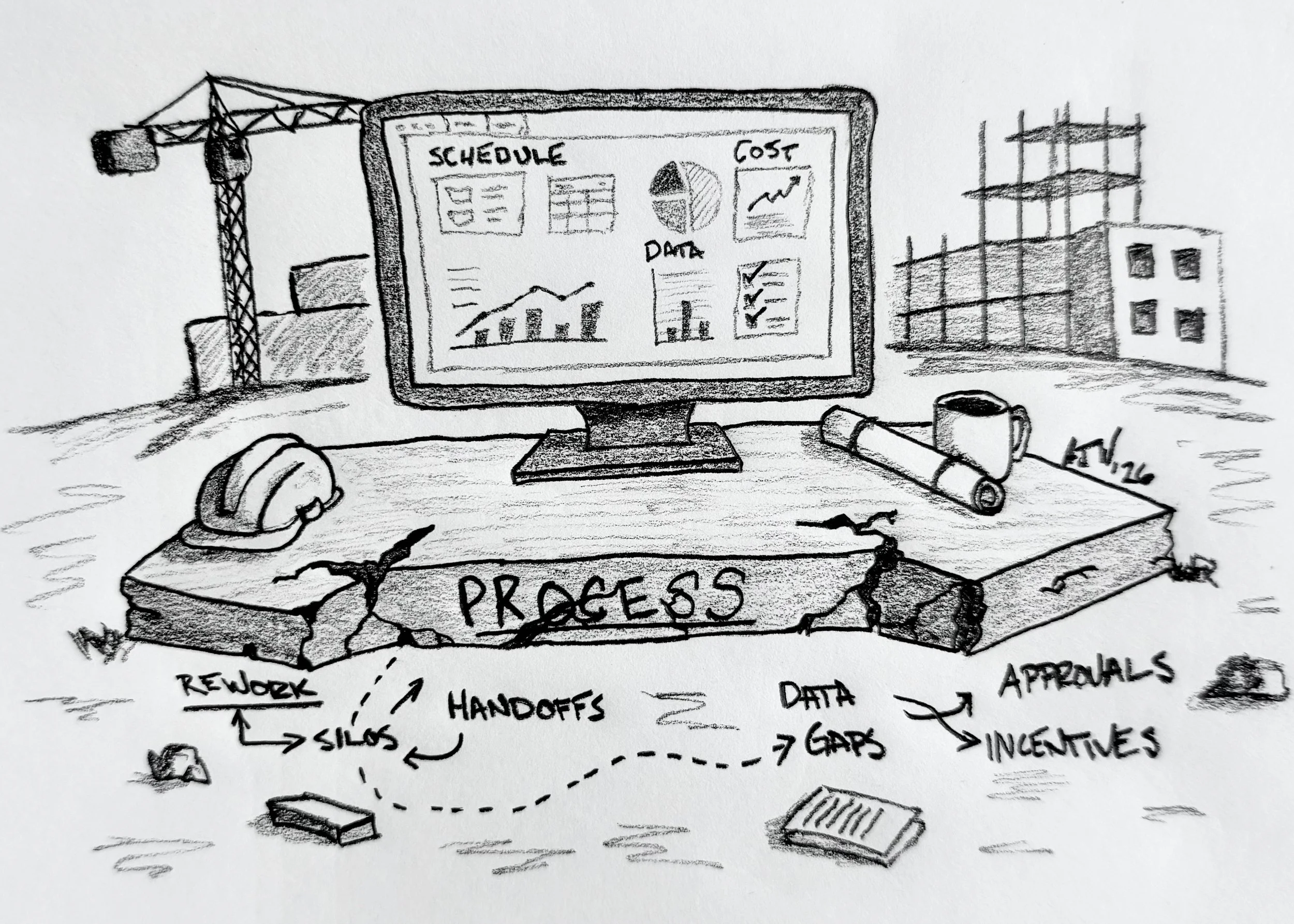
Construction doesn’t have a technology scarcity problem.
It has a systems design problem.
We’ve tolerated friction because addition feels like progress. We’ve accepted complexity because it masquerades as sophistication. We’ve protected old habits instead of truly interrogating them.
The opportunity in front of us is enormous. We have more powerful platforms than ever, with actual configurable architectures and AI capabilities that sounded like science fiction a decade ago. What we need now is the courage to rethink how we build, not just what we buy.
Let’s stop assuming the next tool will save us and start asking where our workflows create the drag. Subtract before we add. Define before we automate. Align our people, our processes and our platform (in that order). When those three elements move together, technology stops being a burden and starts becoming infrastructure.
Construction has never lacked grit. It has never lacked intelligence. It certainly has never lacked effort. What it has lacked is a unified operating system for how projects truly run.
The bottleneck was never the tools, it was the architecture of how we build. And we finally have the chance to redesign it.
Construction is cool, tell your friends!